
Yeast Iron vs. Iron Bisglycinate: Differences, Bioavailability, and Formulation Considerations
Selecting the appropriate iron ingredient is an important decision for dietary supplement manufacturers. Ingredient form can influence product composition, elemental iron delivery, formulation compatibility, and the evidence available to support product positioning. Among the options used in supplement development, yeast iron and iron bisglycinate differ in their production methods, ingredient characteristics, and documentation requirements.
Choosing between these ingredients requires more than comparing their names or general descriptions. Manufacturers should evaluate the specifications of the actual ingredient, the quality of supporting research, the intended dosage form, and the requirements of the target market. Contact Yangge Biotech at info@yanggebiotech.com to discuss your ingredient requirements and request the relevant Certificate of Analysis (COA), subject to confirmation of ingredient availability.
This guide examines the key differences between yeast iron and iron bisglycinate, with a focus on ingredient evaluation, formulation development, quality verification, supplier selection, and OEM packaging considerations for supplement brands.
What Is Yeast Iron?
Yeast iron generally refers to an ingredient produced by cultivating yeast in a medium containing iron, allowing iron to become incorporated into the yeast biomass. Its final composition depends on the yeast strain, production process, and manufacturing specifications.
For supplement manufacturers, understanding the specific ingredient is essential. The term yeast iron alone does not establish its exact iron content, chemical composition, or nutritional performance. These characteristics should be verified through supplier documentation and relevant analytical data.
Key considerations for supplement development
Elemental iron content: Confirm the declared iron concentration and the amount delivered per serving.
Ingredient composition: Review the product specification to understand the yeast-derived material and any relevant compositional details.
Sensory characteristics: Evaluate color, odor, and flavor, particularly when developing powders, chewables, or flavored formulations.
Quality requirements: Review applicable microbiological, contaminant, and identity specifications.
Application suitability: Test the ingredient in the intended dosage form to assess processing behavior and compatibility.
Yeast iron may be considered for different supplement formats, depending on the specific ingredient and its technical characteristics. Manufacturers should confirm suitability through documentation and formulation trials rather than assuming that all yeast iron products perform identically.
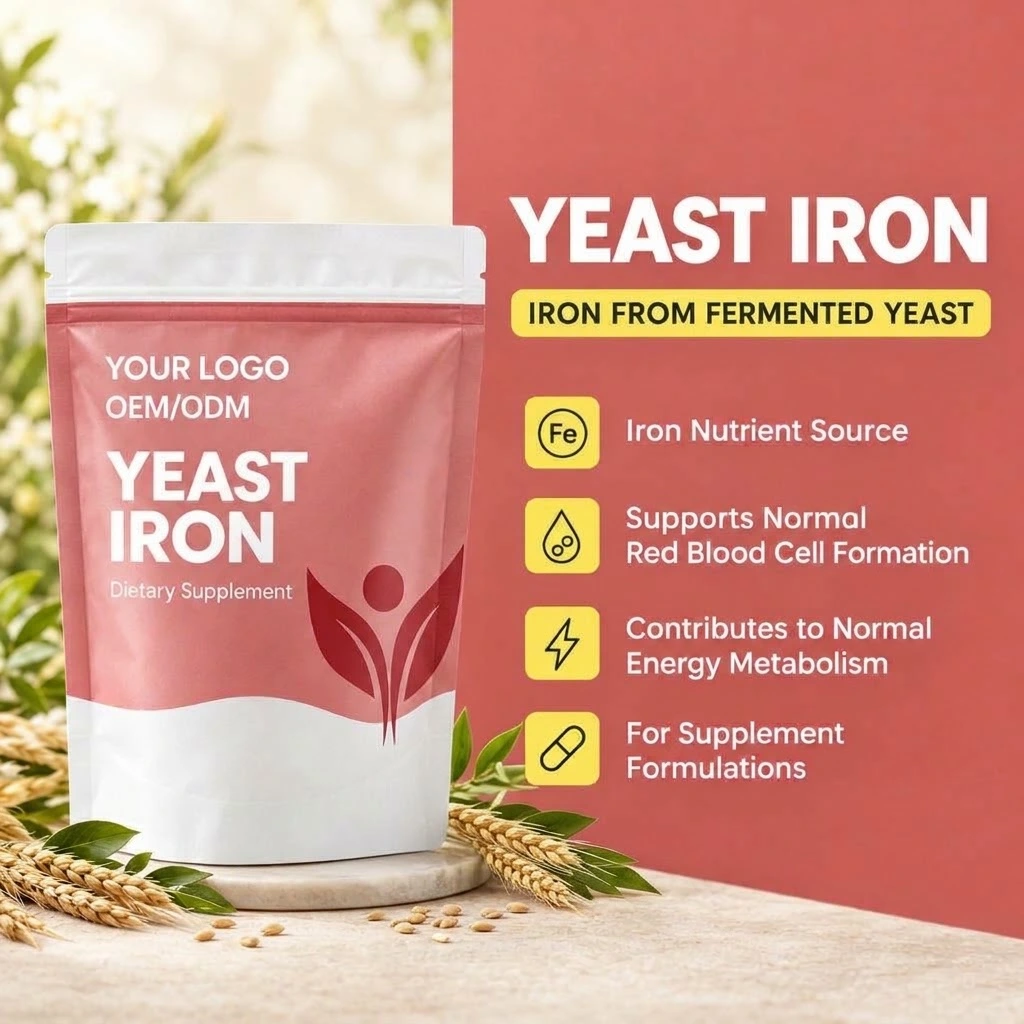
What Is Iron Bisglycinate?
Iron bisglycinate is a chelated iron ingredient in which iron is associated with glycine. It is used in dietary supplement formulations and is often evaluated by manufacturers seeking a defined iron source with supporting research relevant to absorption and tolerability.
As with other mineral ingredients, product specifications remain important. Buyers should verify the ingredient’s identity, elemental iron content, quality parameters, and suitability for the intended application.
Key considerations for supplement development
Elemental iron delivery: Calculate the amount of elemental iron supplied by the ingredient rather than relying on the total ingredient weight.
Chelated form verification: Confirm the identity and specification of the supplied material.
Dosage-form compatibility: Assess suitability for capsules, tablets, powders, and other intended product formats.
Blend compatibility: Evaluate interactions with other vitamins, minerals, excipients, and formulation components.
Evidence quality: Review human research relevant to the specific form, dose, population, and outcome before making product claims.
Iron bisglycinate has been investigated in human research, including studies examining iron status and gastrointestinal tolerability. However, findings should be interpreted in context. Evidence from one study or product does not automatically establish the performance of every ingredient sold under the same general name.
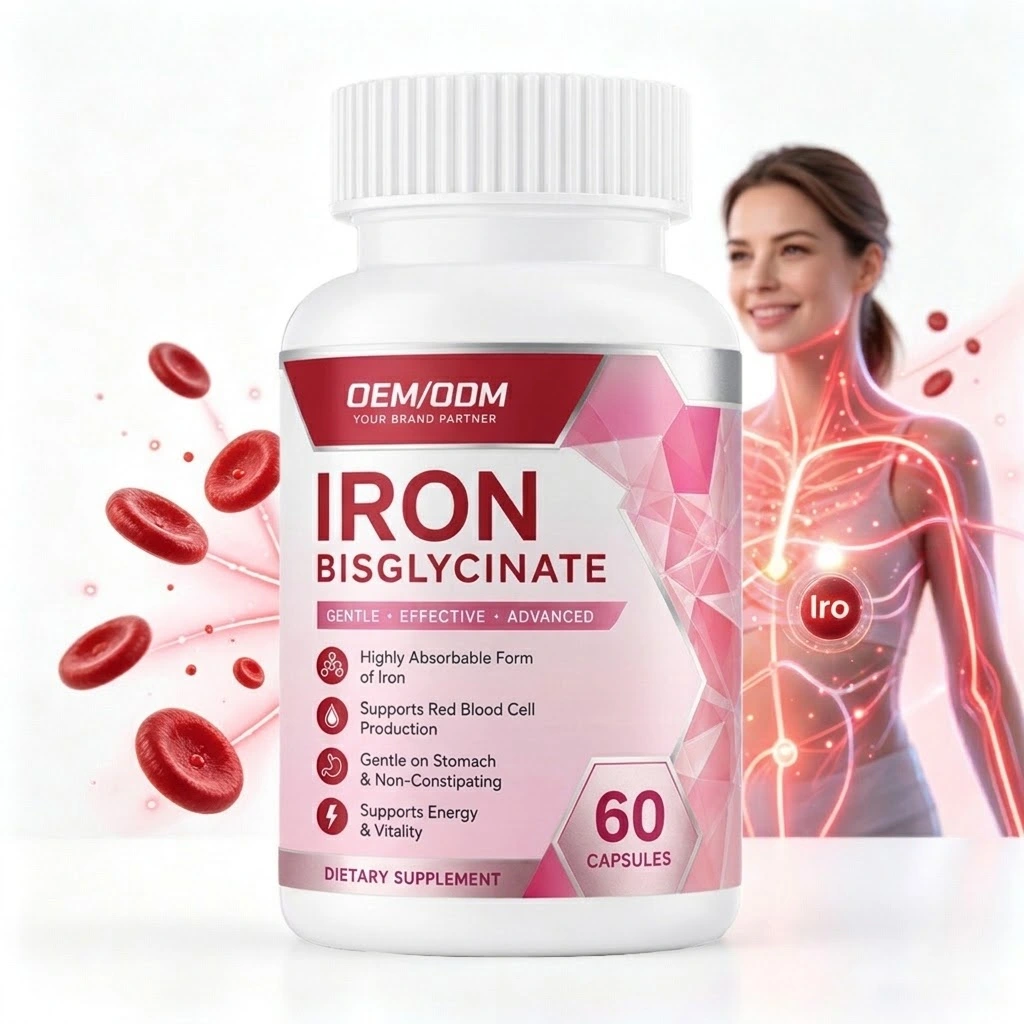
Yeast Iron vs. Iron Bisglycinate: Key Differences
The most useful comparison considers ingredient identity, documented iron content, available evidence, formulation performance, and supplier quality information.
| Evaluation factor | Yeast iron | Iron bisglycinate |
|---|---|---|
| Ingredient form | Iron associated with yeast biomass; composition depends on the product | Iron associated with glycine in a chelated form |
| Elemental iron content | Confirm using the product specification and analytical documentation | Confirm using the product specification and analytical documentation |
| Bioavailability evidence | Assess research relevant to the specific ingredient | Human research is available for certain uses, but findings depend on study conditions |
| Tolerability | Requires evidence relevant to the ingredient, dose, and intended population | Some studies suggest improved gastrointestinal tolerability compared with certain iron salts; results are not universal |
| Sensory considerations | Assess color, flavor, odor, and effects on the finished formula | Assess sensory effects and compatibility in the finished formula |
| Formulation requirements | Evaluate blend uniformity, processing, and finished-product stability | Evaluate blend uniformity, processing, and finished-product stability |
| Supplier verification | Review identity, composition, iron content, and applicable quality limits | Review identity, iron content, and applicable quality limits |
This is a general comparison and does not establish that one ingredient is universally superior. Final selection should be based on product-specific specifications, appropriate research, and formulation testing.
Bioavailability and Tolerability: How Should the Evidence Be Interpreted?
Bioavailability and gastrointestinal tolerability are important considerations when developing iron supplements. Nevertheless, these outcomes cannot be predicted from an ingredient name alone.
The results of an iron study may depend on the population studied, baseline iron status, dosage, duration, dietary factors, comparison ingredient, and study design. The manufacturing specifications and characteristics of a particular ingredient may also differ from those of the material used in published research.
Evaluating bioavailability evidence
When reviewing research, manufacturers should determine:
Whether the study investigated the same iron form as the proposed ingredient.
Whether the study population resembles the intended consumer group.
Whether the dose and administration conditions are relevant to the planned formulation.
Whether the research measured absorption, changes in iron status, or another outcome.
Whether the results have been replicated in suitable studies.
These distinctions matter because absorption measurements, changes in iron status, and broader health outcomes are not interchangeable.
Evaluating tolerability
Iron supplementation can cause gastrointestinal effects, but the likelihood and severity may vary with the iron form, dose, administration conditions, and individual factors. Although some research suggests that iron bisglycinate may be better tolerated than certain conventional iron salts in particular populations, this should not be presented as a guarantee.
For yeast iron, manufacturers should seek research that directly supports claims about the specific ingredient rather than extrapolating from general information about yeast-derived materials.
For product developers: Use evidence that matches the ingredient, dose, target population, and proposed claim. Where direct evidence is limited, state that limitation rather than implying proven superiority.
Formulation Considerations for Iron Supplements
Ingredient selection is only one part of developing a finished iron supplement. Manufacturers must also evaluate processing conditions, serving-size requirements, compatibility, and finished-product quality.
Capsules and tablets
For capsules and tablets, development teams should calculate the required ingredient quantity based on its verified elemental iron content. They should also evaluate blend uniformity, flow properties, excipient compatibility, and the ability of the manufacturing process to deliver the intended amount consistently.
The final specification should define the required iron content and relevant quality parameters for the finished product.
Powders and premixes
Powdered formulations require attention to particle characteristics, dispersion, flavor, color, moisture control, and uniform distribution throughout the blend. Other ingredients may affect sensory properties or processing performance, so testing should be conducted using the actual proposed formulation.
Where multiple minerals or botanical ingredients are combined, manufacturers should assess compatibility and monitor relevant quality attributes during storage.
Stability and packaging
Stability should be assessed under conditions appropriate to the product’s intended packaging, storage environment, and shelf life. Testing may include appearance, moisture-related changes, relevant analytical measurements, and other parameters defined by the finished-product specification.
Packaging should be selected based on the formulation’s protection requirements and applicable stability data. Shelf-life claims should be supported by suitable evidence rather than assumed from the stability of an individual raw material.
How to Evaluate an Iron Ingredient Supplier
For B2B buyers, supplier evaluation should establish whether the ingredient meets technical, quality, regulatory, and commercial requirements.
Buyer checklist
Request the COA: Review the Certificate of Analysis for the relevant batch, where available, and compare reported results with the agreed specification.
Confirm elemental iron content: Verify the declared concentration and calculate the ingredient quantity needed to meet the target serving level.
Review the product specification: Check ingredient identity, composition, relevant physical properties, and applicable quality limits.
Request technical documentation: Obtain the Technical Data Sheet and other available information relevant to handling and formulation.
Review safety information: Assess applicable microbiological, contaminant, allergen, and other safety documentation.
Verify regulatory suitability: Confirm the ingredient’s permitted use, labeling requirements, and other obligations in the intended market.
Request samples where available: Conduct laboratory and prototype trials before committing to commercial-scale production.
Confirm commercial terms: Discuss minimum order quantity, pricing, packaging, lead time, and supply capacity.
Document approval criteria: Establish acceptance requirements for incoming materials and finished products before placing a bulk order.
Working with Yangge Biotech
Yangge Biotech supports B2B ingredient inquiries and can discuss documentation and sourcing requirements for requested ingredients. Buyers should confirm whether the required iron ingredient is available and which specifications, COA documents, technical information, and sample options can be provided.
Contact info@yanggebiotech.com to discuss your formulation requirements and request applicable documentation.
Specific ingredient availability, documentation, samples, and commercial terms must be confirmed directly with Yangge Biotech.
Which Iron Ingredient Is Right for Your Supplement Brand?
There is no single answer that applies to every supplement formulation. Yeast iron and iron bisglycinate should be evaluated against the same practical criteria: verified elemental iron content, ingredient identity, relevant research, sensory performance, compatibility, quality requirements, and cost at the intended dosage.
A manufacturer prioritizing a particular ingredient profile should confirm that the supplied material meets the corresponding specification. A brand considering bioavailability or tolerability positioning should also ensure that the evidence directly supports the intended claim and target population.
The final decision should be based on a combination of supplier documentation, evidence review, prototype testing, and commercial feasibility.
OEM Packaging Services for Iron Supplements: Build Your Own Supplement Brand
For businesses planning to introduce an iron supplement or expand an existing product line, OEM packaging services can help translate a product concept into brand-specific packaging. Packaging selection, label design, product presentation, and format suitability are important considerations when preparing a supplement for the market.
Yangge Biotech offers OEM/ODM-related services for B2B customers. The specific services available for an iron supplement project should be confirmed directly with the team.
OEM packaging options to discuss
Depending on the product format and confirmed project requirements, packaging options may include:
Bottles and jars: For suitable capsule, tablet, and powdered supplement products.
Stand-up pouches: Flexible packaging options for appropriate powder formulations.
Sachets and stick packs: Single-serving formats for suitable powdered products.
Custom label design: Brand-specific colors, product names, and packaging information.
Customized packaging presentation: Packaging materials, sizes, and design elements aligned with the brand’s identity.
The final packaging format should be compatible with the formulation, intended storage conditions, product protection requirements, and applicable labeling regulations.
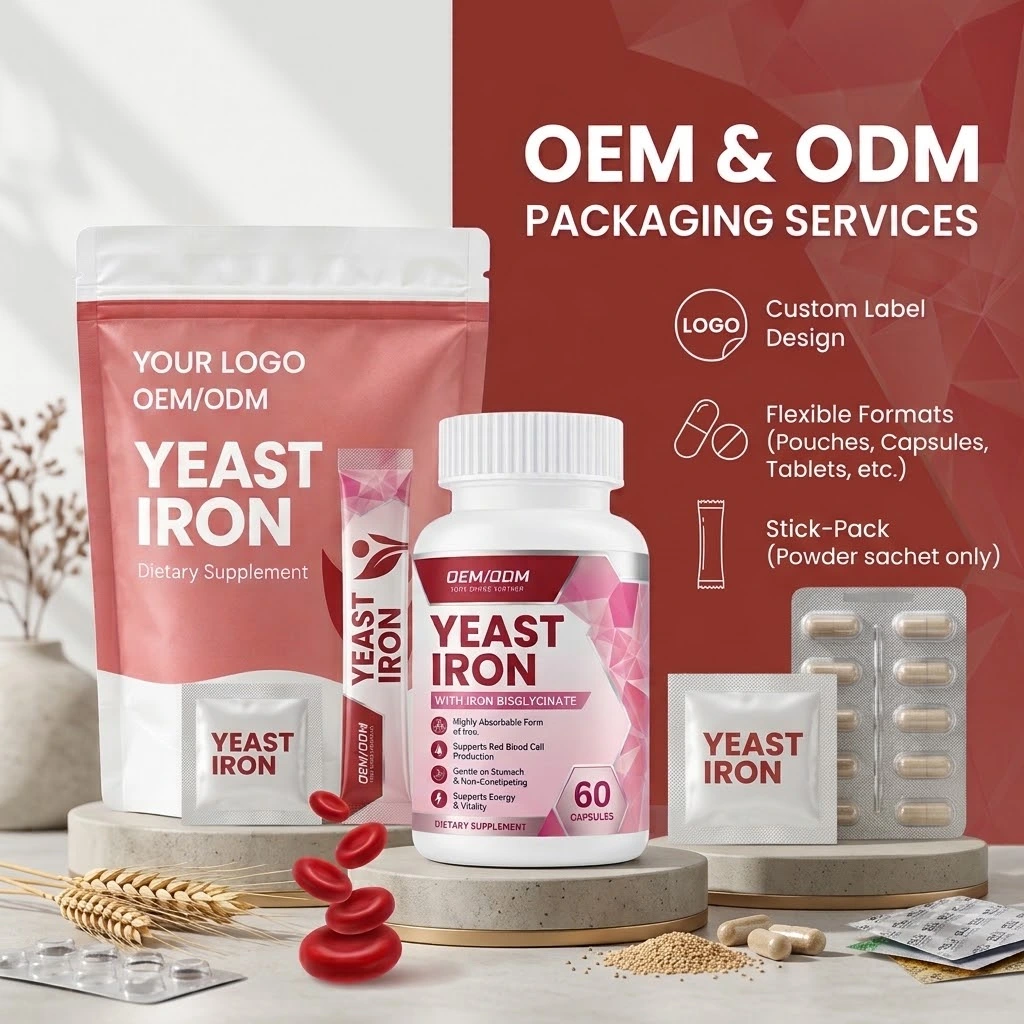
What to prepare before requesting OEM services
To help the team assess your project, prepare the following details:
Product concept: Identify whether your proposed formulation uses yeast iron, iron bisglycinate, or another ingredient.
Dosage form: Specify whether you plan to develop capsules, tablets, or powder products.
Target market: Identify the destination country or region to help determine applicable regulatory and labeling requirements.
Packaging preferences: Share your preferred format, package size, color scheme, and design references.
Order quantity: Provide an estimated order volume and anticipated launch schedule.
Documentation requirements: List the specifications, COA, and other technical or quality documents required for evaluation.
Start Your OEM Supplement Project with Yangge Biotech
Yangge Biotech works with B2B customers on ingredient sourcing and OEM/ODM-related inquiries. Contact the team to discuss your ingredient requirements, packaging concept, customization needs, and potential project scope.
Email: info@yanggebiotech.com
Ingredient availability, finished-product manufacturing, packaging formats, customization options, and related services must be confirmed directly with Yangge Biotech. OEM packaging availability does not by itself establish that a specific finished iron supplement can be manufactured or supplied.
Conclusion
Yeast iron and iron bisglycinate have different ingredient characteristics that supplement manufacturers should evaluate before selecting a raw material. Yeast iron requires attention to the composition and specifications of the particular yeast-derived ingredient, while iron bisglycinate requires verification of its identity, elemental iron content, and the relevance of supporting research.
Neither ingredient should be selected solely on the basis of a general claim about absorption, tolerability, or quality. A more reliable approach combines product-specific documentation, appropriate evidence, formulation testing, and supplier verification.
For brands planning to launch a new supplement, these steps can also inform dosage-form selection, packaging requirements, and potential OEM project discussions. Careful evaluation at each stage helps businesses make better-informed sourcing and product-development decisions.
Frequently Asked Questions
1. What is the main difference between yeast iron and iron bisglycinate?
Yeast iron generally refers to iron incorporated into yeast biomass, while iron bisglycinate is a chelated form of iron associated with glycine. Their exact specifications and suitability should be confirmed for the individual products being considered.
2. Does iron bisglycinate have better bioavailability than yeast iron?
The answer depends on the ingredients being compared and the available evidence. Research on one iron bisglycinate product cannot automatically establish superiority over every yeast iron ingredient. Directly relevant comparative evidence is preferable.
3. Which iron ingredient is better tolerated?
Some studies suggest that iron bisglycinate may have gastrointestinal tolerability advantages over certain conventional iron salts in particular settings. However, tolerability depends on several factors, and a universal comparison with yeast iron is not justified without appropriate evidence.
4. Can these ingredients be used in capsules and tablets?
They may be suitable for these dosage forms depending on their specifications and the finished formulation. Manufacturers should evaluate elemental iron delivery, blend uniformity, excipient compatibility, and product stability before production.
5. What documents should buyers request from an iron ingredient supplier?
Buyers should request the applicable product specification, COA, TDS, and available safety and regulatory documentation. Additional testing or documentation may be necessary depending on the ingredient and destination market.
6. How can manufacturers verify elemental iron content?
Review the product specification and relevant analytical documentation, then confirm the ingredient quantity needed to deliver the target amount of elemental iron. Finished-product testing should verify that the manufactured product meets its established requirements.
7. Does Yangge Biotech offer OEM packaging services?
Yangge Biotech offers OEM/ODM-related services for B2B customers. Contact info@yanggebiotech.com to confirm the availability of relevant packaging formats, customization options, documentation, and project requirements for your proposed supplement.


_1787122526735.webp "Blue Butterfly Pea Flower Extract")