
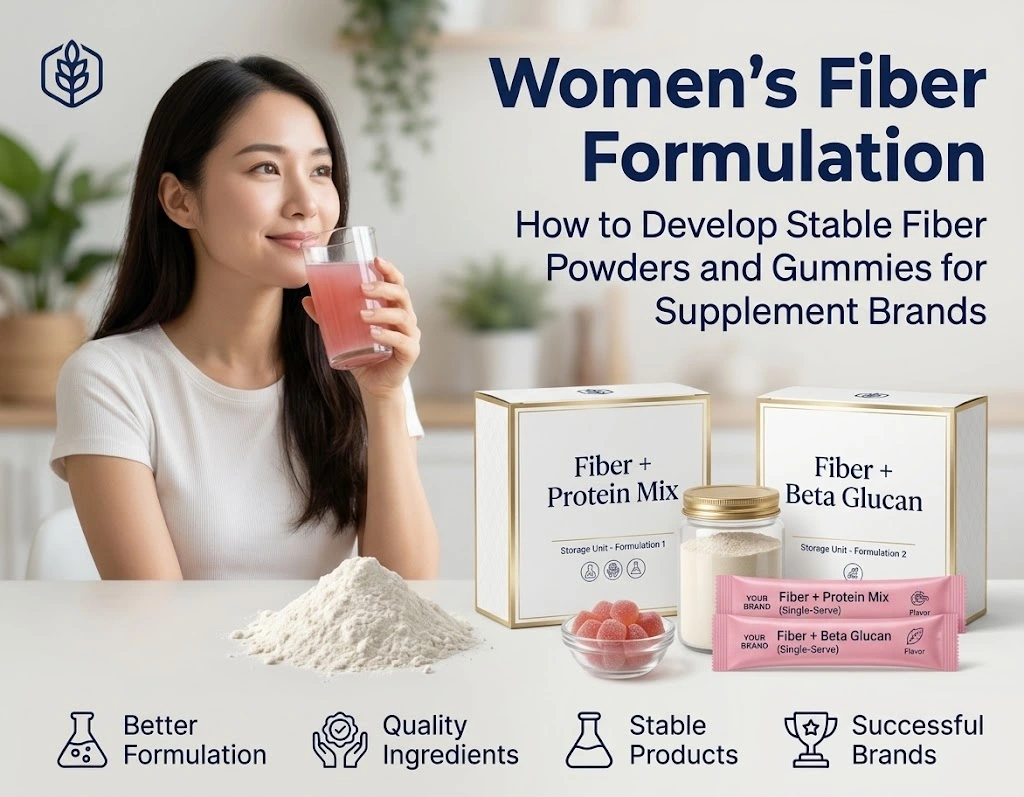
Women’s Fiber Formulation: How to Develop Stable Fiber Powders and Gummies for Supplement Brands
Women’s fiber formulation requires more than selecting a dietary fiber ingredient and adding it to a supplement blend. Manufacturers must consider fiber composition, serving size, digestive tolerance, solubility, moisture control, and finished-product stability. For brands developing women’s health supplements, the challenge is to deliver a practical amount of dietary fiber while maintaining acceptable taste, texture, processing performance, and label accuracy. The right formulation depends on the specific fiber grade, intended application, and target market. Before scaling up, B2B buyers should verify ingredient specifications, batch quality, regulatory suitability, and supplier documentation. Contact Yangge Biotech at info@yanggebiotech.com to discuss your ingredient requirements and request the relevant Certificate of Analysis (COA), subject to confirmation of ingredient availability.
Understanding the Challenges of Women’s Fiber Formulation
Women’s fiber supplements are not a single product category with one universal formulation. Products may be developed for everyday nutritional intake, convenient drink mixes, chewable gummies, or broader women’s health product lines. Each application presents different technical requirements.
Dietary fibers differ in their solubility, viscosity, fermentability, particle size, and water-binding properties. These characteristics influence how an ingredient behaves during mixing, manufacturing, storage, and consumption.
For supplement manufacturers, the first step is to define the intended product format and nutritional objective. A fiber powder designed to dissolve in water has different requirements from a gummy that must maintain its shape and texture during storage.
Why Fiber Type Matters in Formulation
Soluble and insoluble fibers do not behave identically. Some soluble fibers dissolve readily, while others increase viscosity or form thicker mixtures. Insoluble fibers may contribute bulk but can also affect mouthfeel, sedimentation, and product uniformity.
These differences matter when determining the amount of fiber that can be incorporated into a serving without compromising product quality.
A fiber ingredient that performs well in a dry powder may not be suitable for a gummy without additional formulation work. Similarly, a fiber’s nutritional properties do not automatically establish its compatibility with every vitamin, mineral, botanical extract, or sweetener.
Ingredient selection should therefore consider both the intended nutritional contribution and the technical demands of the finished product.
Why Women’s Health Products Need Clear Formulation Objectives
Women’s health is a broad market covering consumers with different nutritional needs, preferences, and life stages. Manufacturers should define the intended audience rather than assuming that one fiber formulation is appropriate for all women.
For example, an everyday fiber powder may prioritize convenient preparation and a manageable serving size. A gummy may prioritize chewability, taste, and stability. A product intended for midlife consumers may require additional attention to the evidence supporting its positioning and any related claims.
A women-focused product concept does not, by itself, demonstrate a special physiological benefit. Claims about digestive regularity, microbiome effects, menopause, or weight management must be assessed against relevant ingredient-specific evidence and applicable regulations.
What Formulation Problems Can Cost B2B Buyers
Poor ingredient selection can lead to production difficulties, excessive viscosity, unacceptable texture, inconsistent fiber content, or shelf-life problems. Manufacturers may then need to revise the formula, repeat pilot batches, change packaging, or delay commercialization.
The following table summarizes common development risks.
| Formulation issue | Potential impact | Recommended evaluation |
|---|---|---|
| Incorrect fiber specification | Inconsistent nutritional contribution | Verify identity, composition, and analytical data |
| Poor dispersibility | Lumps or uneven distribution | Conduct mixing and dispersion trials |
| Excessive viscosity | Difficult processing or consumption | Measure viscosity at the intended concentration |
| Poor digestive tolerance | Consumer discomfort in some users | Review ingredient-specific evidence and serving size |
| Gummy texture changes | Hardness, stickiness, or uneven structure | Conduct texture and stability testing |
| Moisture migration | Changes in quality during storage | Evaluate moisture, water activity, and packaging |
| Unsupported label claims | Regulatory and commercial risk | Review evidence and market-specific requirements |
These risks cannot be eliminated by a supplier COA alone. They require a combination of raw-material verification, formulation trials, finished-product testing, and regulatory review.
Key Factors Affecting Fiber Powder Formulation
Developing a fiber powder involves balancing nutritional targets with mixing performance, sensory quality, and storage conditions. The specific requirements depend on the fiber grade and the other ingredients included in the formula.
Solubility, Dispersibility, and Viscosity
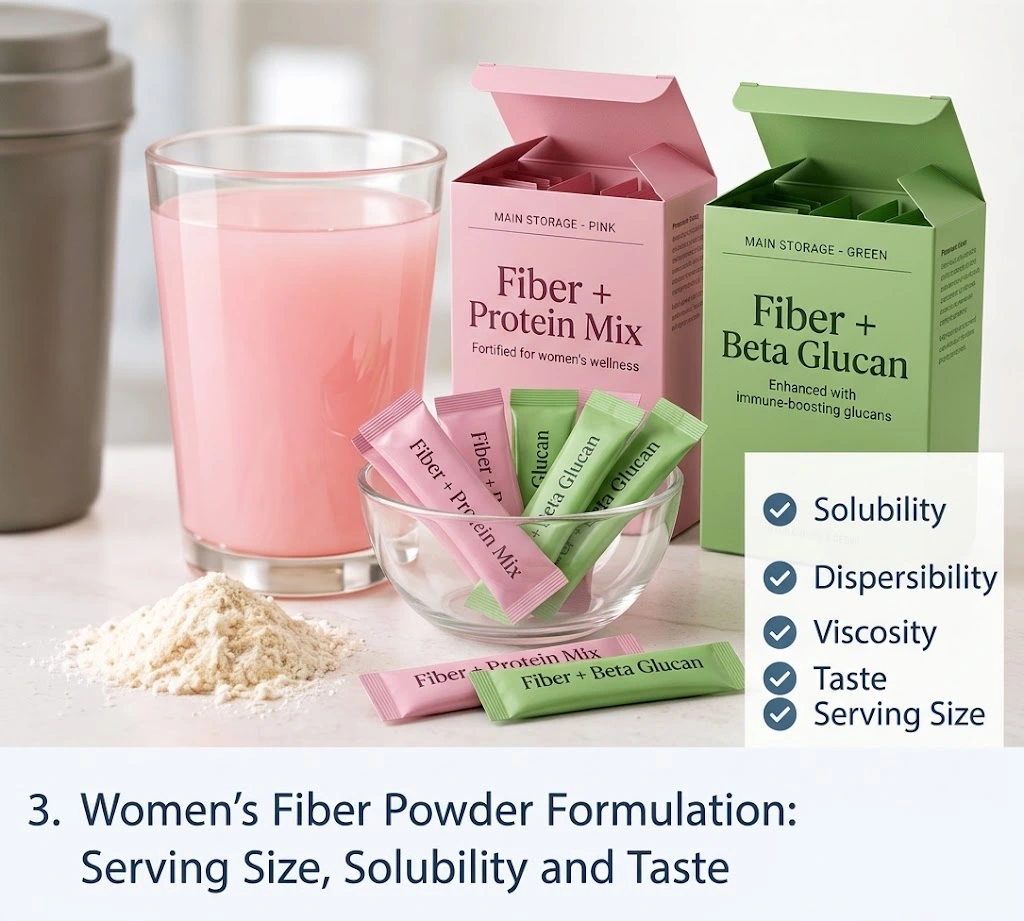
Solubility describes whether an ingredient dissolves in a liquid. Dispersibility describes how evenly particles distribute through a liquid, even when they do not dissolve completely.
The distinction is important for drink mixes. A product may disperse adequately while still forming a suspension or becoming thicker over time.
During development, manufacturers should assess:
Wetting and lump formation during mixing.
Mixing time and preparation instructions.
Viscosity immediately after preparation and after standing.
Sedimentation or separation.
Mouthfeel at the proposed serving size.
Compatibility with flavors, sweeteners, minerals, and other ingredients.
Tests should use the actual ingredient grade and intended preparation method. Results from one concentration or water volume should not automatically be applied to a different formulation.
Fiber Content and Serving Size
The required amount of fiber ingredient depends on its verified composition and the target fiber content of the finished product.
For example, if an ingredient contains other carbohydrates, carriers, moisture, or additional constituents, the total ingredient weight may not equal the amount of dietary fiber declared on the label.
Manufacturers should calculate the required inclusion rate using verified composition data and an appropriate analytical method. They should also account for other components in the serving, including flavors, sweeteners, and active ingredients.
In the United States, whether an added isolated or synthetic nondigestible carbohydrate qualifies for declaration as dietary fiber depends on the applicable FDA definition and regulatory guidance. Not every ingredient described as a fiber automatically qualifies.
Digestive Tolerance and Consumer Instructions
Some fermentable fibers may cause gas, bloating, or abdominal discomfort in certain individuals. The response can vary with fiber type, amount consumed, individual sensitivity, and the overall diet.
For this reason, manufacturers should evaluate the proposed serving size rather than assuming that a higher fiber inclusion rate always produces a better product.
Consumer directions should be appropriate for the ingredient and finished formulation. Where relevant, the product team should assess gradual introduction and fluid-intake guidance with suitable scientific and regulatory review.
Evidence for one fiber cannot automatically establish the tolerance profile of another. Supplier documentation should be supplemented by relevant research and, where appropriate, product-specific testing.
Developing Fiber Gummies: Texture, Moisture, and Shelf-Life Control
Fiber gummies offer a chewable alternative to powders, but adding fiber can change how the gummy mixture behaves during processing and storage.
A gummy typically contains a combination of water, sweeteners, a gelling system, acids, flavors, and other ingredients. Introducing dietary fiber may affect viscosity, water distribution, texture, and the finished product’s physical stability.
A 2026 research study examining green rice husk dietary fiber in gummies found that fiber concentration and the type of hydrocolloid influenced properties including texture and product uniformity. The findings demonstrate the importance of optimizing the complete formulation, but they do not establish that the same results will occur with every commercial fiber ingredient. <Cite refs={["turn717661search1","turn717661search12"]}/>
Fiber Loading and Gummy Texture
The amount and physical properties of the selected fiber may affect the gummy’s hardness, elasticity, chewiness, and smoothness.
Insoluble particles may also affect uniformity or settle if the formulation does not adequately suspend them before the gel structure sets. Soluble fibers can influence viscosity and interact with other components of the gummy matrix.
Manufacturers should evaluate the fiber alongside the gelling agent, sweetener system, acids, and processing conditions. Increasing fiber content without checking these interactions may produce a gummy that is difficult to deposit or does not meet the intended sensory specifications.
Moisture Content and Water Activity
Moisture content and water activity are different measurements.
Moisture content measures the amount of water in a product, while water activity indicates how available that water is for chemical reactions and microbial growth. Both measurements can be relevant to gummy quality, but neither should be interpreted in isolation.
Changes in moisture distribution may contribute to stickiness, hardening, or other texture changes. Water activity is also important when assessing microbial stability, but a water activity result alone does not establish that a product is safe or commercially stable.
The appropriate limits must be established for the particular formulation, packaging, manufacturing process, and intended storage conditions. General values from another gummy study should not be treated as universal acceptance criteria.

Stability Testing for Fiber Gummies
A suitable stability program should evaluate the finished gummy over time rather than relying solely on the raw-material specification.
| Test area | What to evaluate | Why it matters |
|---|---|---|
| Appearance | Shape, color, surface condition, visible separation | Identifies physical changes |
| Texture | Hardness, elasticity, chewiness, stickiness | Checks product consistency |
| Moisture | Moisture content and changes during storage | Helps track water movement |
| Water activity | Measured value over the study period | Supports stability and microbial-risk assessment |
| Microbiological quality | Relevant organisms and acceptance criteria | Supports product safety |
| Nutritional composition | Fiber content using an appropriate method | Supports label accuracy |
| Packaging | Seal integrity and moisture-barrier performance | Evaluates protection during storage |
Accelerated studies can help identify potential issues, but they do not automatically prove a commercial shelf life. Real-time stability data and scientifically justified acceptance criteria may also be required.
A 2026 review of gummy dietary supplement manufacturing and testing likewise highlights the importance of formulation, manufacturing controls, and analytical testing in achieving product quality and consistency.
Comparing Fiber Powder and Gummy Applications
The choice between powders and gummies should be based on the target product, intended fiber content, manufacturing capabilities, and consumer requirements.
| Development factor | Fiber powder | Fiber gummy |
|---|---|---|
| Serving design | Can accommodate relatively large ingredient quantities, depending on the formula | Limited by piece size, texture, and total solids |
| Main technical challenge | Dispersibility, viscosity, and mouthfeel | Gel structure, texture, and moisture control |
| Sensory considerations | Taste, grittiness, and thickness | Chewiness, sweetness, stickiness, and flavor |
| Processing considerations | Blending uniformity and humidity control | Heating, mixing, depositing, and setting |
| Stability priorities | Moisture protection, caking, and ingredient compatibility | Moisture migration, texture changes, and microbial quality |
| Packaging options | Tubs, pouches, and stick packs | Bottles, jars, and suitable moisture-protective packs |
| Verification | Fiber composition, blend uniformity, and storage quality | Fiber content, texture, water activity, microbiological quality, and storage performance |
These are general formulation considerations, not guarantees that one format will outperform another. Final selection requires testing with the specific fiber and finished formula.
Combining Fiber With Other Ingredients in Women’s Health Products
Brands may consider combining dietary fiber with vitamins, minerals, botanical extracts, or other functional ingredients. These combinations should be developed around a clear product objective and supported by appropriate compatibility testing.
Fiber and Vitamins or Minerals
When combining fiber with micronutrients, the development team should consider serving size, taste, processing conditions, and the stability of each component.
The presence of fiber does not establish that every vitamin or mineral will be absorbed more efficiently. Any claim about nutrient absorption or a specific physiological effect requires relevant evidence for the ingredients and conditions involved.
Fiber and Botanical Extracts
Botanical extracts can introduce changes in color, odor, flavor, and chemical stability. Their behavior may also depend on moisture, pH, temperature, and the other components in the formula.
Before combining a botanical with fiber, manufacturers should review ingredient identity, composition, safety documentation, and compatibility with the intended product format.
Evidence supporting an individual botanical or fiber does not automatically establish the effectiveness of the combined product.
Fiber and Prebiotic Positioning
Certain fibers have been investigated for their effects on intestinal microorganisms. However, the term prebiotic should not be used as a substitute for ingredient-specific evidence.
The evidence may depend on the fiber source, dose, population, study duration, and measured outcome. Product developers should also distinguish between scientific evidence of an effect and permission to make a particular marketing claim in the intended market.
Practical Procurement Recommendations for B2B Buyers
The quality of a women’s fiber supplement depends partly on decisions made before formulation begins. Buyers should confirm that a potential supplier can provide the exact ingredient, grade, documentation, and commercial terms required for the project.
What to Request Before Placing a Bulk Order
Ask the supplier for the following documents and details, as applicable to the ingredient:
Certificate of Analysis (COA): Batch-specific results for relevant identity, composition, and quality parameters.
Technical Data Sheet (TDS): Available information on ingredient properties, handling, and application.
Product specification: Defined requirements for composition, fiber content, physical properties, and relevant quality limits.
Safety documentation: Relevant microbiological, contaminant, and allergen information.
Regulatory information: Documentation needed to assess suitability for the destination market.
Sample availability: Material for laboratory trials and prototype evaluation.
Commercial terms: MOQ, lead time, packaging options, pricing, and confirmed supply capacity.
Yangge Biotech can help buyers obtain relevant ingredient documentation and discuss sourcing requirements. Contact the team at info@yanggebiotech.com to confirm the availability of your required fiber ingredient, request its COA and TDS, and discuss samples and bulk-order specifications.
Confirm Ingredient Availability and Specifications
Before approving a fiber ingredient, buyers should verify its exact identity, grade, composition, and intended application.
Do not assume that a supplier carries a particular fiber type or can provide a requested concentration without confirmation. Likewise, claims about certifications, production capacity, inventory, and delivery schedules should be supported by current documentation.
For projects intended for the United States or European Union, the regulatory status of the specific ingredient and the proposed product claims should be reviewed before launch.
OEM and Private Label Considerations
Yangge can pack OEM items in three different sizes: 60 g, 100 g, and 8 oz. For the right price, you can have capsules, tablets, powders, and gummies made just the way you want them. The supplier's technical team should be involved early in the formulation stage, before pilot tests. This cuts down on the time it takes to get the product to market and the number of times it needs to be adjusted.

Conclusion
Women’s fiber formulation requires a balance between nutritional objectives, ingredient characteristics, sensory performance, manufacturing feasibility, and product stability. Fiber powders and gummies each present different development challenges, and neither format can be optimized through ingredient selection alone.For powder products, developers should assess fiber content, dispersibility, viscosity, taste, and moisture protection. For gummies, the focus should include fiber loading, gel structure, texture, water activity, packaging, and shelf-life testing. Evidence limitations also matter. The effects and tolerance of a particular fiber should not be generalized to all fiber ingredients, and a formulation trend does not establish a specific health benefit. Regulatory suitability and labeling requirements must be verified for the intended market.
Frequently Asked Questions
Which fiber is best for women’s supplement formulation?
There is no single best fiber for every application. Selection depends on the intended nutritional contribution, ingredient composition, serving size, sensory properties, processing conditions, and target market. Manufacturers should compare verified specifications and test the ingredient in the finished formula.
Are fiber powders easier to formulate than fiber gummies?
Powders can often accommodate larger ingredient quantities without the structural constraints of a gummy. However, they still require careful control of dispersion, viscosity, taste, and humidity. Gummies introduce additional challenges related to gel structure, moisture, texture, and stability.
Why do fiber gummies become hard or sticky?
Possible causes include moisture migration, ingredient interactions, gelling-system behavior, processing conditions, and packaging performance. The actual cause should be identified through product testing and stability investigation rather than assumed from the fiber ingredient alone.
Can all fiber ingredients be declared as dietary fiber on a supplement label?
No. Labeling eligibility depends on the applicable regulations and the specific ingredient. In the United States, certain isolated or synthetic nondigestible carbohydrates must meet the relevant FDA criteria before they can be declared as dietary fiber. Manufacturers should verify current requirements for the ingredient and market.
What documents should I request from a bulk fiber supplier?
Request the applicable COA, TDS, product specification, safety documentation, and regulatory information. Also confirm sample availability, MOQ, lead time, pricing, and supply capacity before approving the ingredient.
How can manufacturers assess fiber ingredient stability?
Stability must be evaluated in the intended product format. Depending on the formulation, testing may include appearance, moisture, water activity, texture, microbiological quality, and fiber content over time. The appropriate test plan and acceptance criteria depend on the finished product.
Partner With Yangge Biotech for Fiber Ingredient Inquiries
Yangge Biotech serves customers in the nutraceutical, dietary supplement, food, and beverage ingredient sectors. If you are developing a women’s fiber powder, gummy, or other supplement concept, contact our team to discuss your ingredient requirements and request relevant technical documentation.
Email: info@yanggebiotech.com
When contacting the team, include your intended application, target fiber content, product format, destination market, and estimated order quantity. Request the relevant Certificate of Analysis (COA), technical data sheet, product specification, and sample information for the ingredient under consideration.
Ingredient availability, specifications, MOQ, lead time, and application suitability must be confirmed before commercial commitments are made.
References
U.S. Food and Drug Administration (FDA). Questions and Answers on Dietary Fiber. https://www.fda.gov/food/nutrition-food-labeling-and-critical-foods/questions-and-answers-dietary-fiber
U.S. Food and Drug Administration (FDA). Review of the Scientific Evidence on the Physiological Effects of Certain Non-Digestible Carbohydrates. https://www.fda.gov/food/nutrition-food-labeling-and-critical-foods/review-scientific-evidence-physiological-effects-certain-non-digestible-carbohydrates
Hu, H., Redan, B., Celiz, M. D., Pawar, R., and Yakes, B. J. Perspective on Gummy Dietary Supplements Manufacturing and Testing. Journal of Dietary Supplements, published online September 17, 2026. https://doi.org/10.1080/19390211.2026.2727022
Effects of Green Rice Husk Dietary Fiber and Hydrocolloids on the Physicochemical, Structural, Bioactive, and Sensory Properties of Gummy Products. Foods, 2026. https://www.mdpi.com/2304-8158/15/7/1114
Gok, S., Toker, O. S., Palabiyik, I., and Konar, N. Usage Possibility of Mannitol and Soluble Wheat Fiber in Low Calorie Gummy Candies. LWT, 2020. https://doi.org/10.1016/j.lwt.2020.109531

Send Inquiry
Related Industry Knowledge
Recommended Products