Which is better, CoQ10 or astaxanthin?
Research examining coq10 vs astaxanthin reveals fascinating contrasts in their mechanisms of action, cellular distribution, and overall effects on human health. Astaxanthin, derived primarily from marine sources, demonstrates unique membrane-spanning capabilities and superior antioxidant potency. Meanwhile, CoQ10, an endogenously produced compound, proves essential for cellular energy production while providing crucial antioxidant protection.
Understanding these distinctions proves particularly valuable for manufacturers developing targeted antioxidant formulations, as the unique properties of each compound create opportunities for both individual and complementary applications in various product categories.
What is CoQ10?
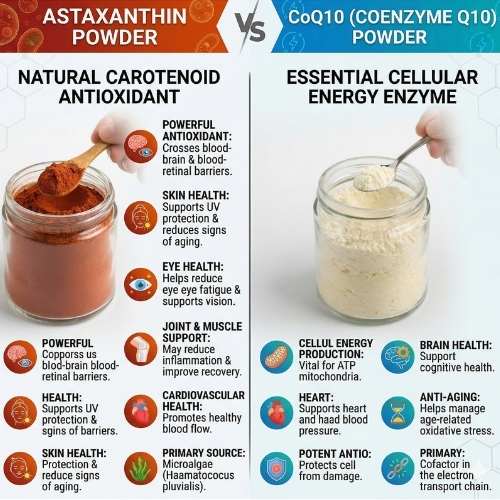
Coenzyme Q10, or CoQ10, is not a vitamin like many people might think; it's a fat-soluble nutrient that our bodies produce naturally. It plays a critical role in our body by ensuring the creation of energy from the mitochondria, which is an especially important process for the health of multiple organs such as the liver, kidneys, brain and especially your heart.
CoQ10 declines with age; therefore, a coenzyme Q10 blood test should be done periodically to ensure you've got sufficient levels. If yours are dipping, the good news is that you can supplement.
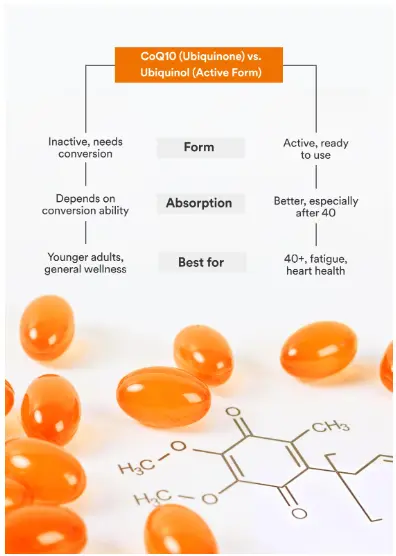
Quick chemistry lesson! CoQ10 has two forms: ubiquinone and ubiquinol. The ubiquinone form is in an oxidized state, which means it's an electron acceptor. The ubiquinol form is in a reduced state, which means it's an electron donor. Ubiquinol has demonstrated a better ability at fighting free radicals.
What is astaxanthin?
Astaxanthin is also not a vitamin. It instead belongs to a class of nutrients called carotenoids, which are specific types of antioxidant nutrients that are produced by several forms of life and contribute to the characteristic colors of those organisms.
Astaxanthin is produced by many different living organisms, but not by humans. However, one species of microalgae called Haematococcus pluvialis produces it particularly efficiently, and animals that eat high concentrations of these algae such as shellfish and red-colored seafood such as crab, lobster, krill, salmon and shrimp take up the astaxanthin which provides their red colors.
Fun fact: did you know that flamingoes are red because their diets are high in a lot of astaxanthin? Now, if you're trying to turn your skin red by consuming more astaxanthin, I hate to be the bearer of bad news, but you probably couldn't consume enough astaxanthin to make a noticeable change in your skin color!
But fortunately, consuming more astaxanthin may provide a range of health benefits (including support for energy production like CoQ10).
What do CoQ10 and astaxanthin have in common? 5 health benefits
Both nutrients have been shown clinically to support healthy aging by providing skin, brain and heart benefits…but they do this in different ways. Let's explore the clinical research on both.
1. Cardiovascular health
In a randomized-controlled trial, 101 people were administered 120 mg of CoQ10 or a placebo for 24 weeks. The results showed that supplementation helped support healthy levels of blood pressure and lipid markers such as triglycerides and LDL. Total antioxidant capacity also significantly improved.
Meanwhile, in a meta-analysis of clinical studies, astaxanthin was shown to support healthy levels of HDL (good cholesterol) and C-reactive protein.
2. Brain health
Astaxanthin and CoQ10 have been studied for their effects on brain health. One clinical study found that astaxanthin supplementation significantly boosted cognitive function in middle-aged and older adults. And observational research has found that CoQ10 levels are positively associated with cognitive function and executive function in older adults.
3. Exercise performance
Trying to get the most out of your workouts? CoQ10 and astaxanthin may belong in your sports nutrition supplement lineup. One study reported a positive relationship between exercise capacity and the concentration of CoQ10 in the thigh muscles of physically active males. In a study on sedentary men, CoQ10 supplementation was associated with increased performance-enhancing effects during repeated bouts of specific exercises. Additionally, one study on firefighters found that ubiquinol supplementation supported a healthy inflammatory response to strenuous exercise compared to placebo.
4. Antioxidant activity
Antioxidants, as the name suggests, help your body fight back against oxidative stress, which happens to the body simply by existing and growing older. Both CoQ10 and astaxanthin have shown supportive effects on antioxidant blood biomarkers in clinical research.
They both are well-known antioxidants, but they achieve this status in different ways. CoQ10 is produced naturally by the body and serves a critical role in mitochondrial function, protecting and powering up your cells.
5. Healthy inflammatory response
Here's something else these two popular nutrients have in common: Large meta-analyses on clinical studies have shown that both CoQ10 and astaxanthin can support healthy levels of a systemic marker of inflammation called C-reactive protein.
Is astaxanthin stronger than CoQ10?
If astaxanthin and CoQ10 were in a boxing match and their boxing skills were determined by the ability to scavenge free radicals, then astaxanthin would probably win! But hold your bets; this doesn't necessarily mean astaxanthin is better than CoQ10. A clinical study comparing them head-to-head within the human body has yet to be performed.
Let me explain. Research has indicated that astaxanthin may be a significantly powerful antioxidant. In fact, according to a review, it is much better at trapping energy from a singlet oxygen than not only CoQ10, but also other antioxidants such as vitamin C, vitamin E and beta-carotene. However, this type of testing was performed in vitro or outside of the body, which doesn't necessarily mean we can translate these results to humans.
Whether or not one is stronger than the other, however, isn't the question to ask. Both compounds have their own importance, and many could benefit from taking both.
Can I take CoQ10 and astaxanthin together?
Yes, there is no reason why these two healthy aging supplements can't be taken together! In fact, pairing them may provide differing benefits to better assist your overall health. However, clinical research evaluating the combination of the two together is limited.
Conclusion: Which Should You Choose?
When evaluating astaxanthin vs CoQ10, both ingredients hold significant value in various health applications due to their potent antioxidant properties and unique benefits. While astaxanthin is recognized for its skin health, anti-inflammatory, and cellular protection capabilities, CoQ10 is widely utilized for its role in energy production and cardiovascular support. This makes both ingredients versatile options for manufacturers aiming to cater to diverse consumer needs.
The decision between CoQ10 vs astaxanthin ultimately depends on the specific application, target demographic, and desired product positioning. Manufacturers can also consider combining these two powerful compounds to create innovative formulations that address multiple health concerns. By understanding the strengths and unique properties of these antioxidants, brands can craft high-quality supplements and functional products that stand out in the competitive health and wellness market.
Partner with Yangge Biotech for Astaxanthin Powder
Yangge Biotech delivers Astaxanthin Powder that meets the most demanding quality specifications in today's competitive marketplace. Our standardized extracts undergo rigorous third-party testing to ensure consistent potency and purity batch after batch. With minimum orders starting at just 1kg and customizable packaginAstaxanthin Powder lion's mane mushroom powder supplier. Our sustainable sourcing practices and comprehensive certifications including ISO, HACCP, Kosher, and Halal provide the documentation your regulatory teams require. Contact our technical specialists at info@yanggebiotech.com to discuss how our premium Astaxanthin Powder can enhance your cognitive health product formulations.
FAQ
Q: Can we get some samples to test before purchasing?
A: Of course, we can provide free samples of 20 to 100 grams, but the shipping cost is at the customer's expense. The shipping cost can be deducted from the next order, or the samples can be sent through your courier account.
Q: Do your products have relevant certifications?
A: Yes, our products are certified for HALAL, ISO, HACCP, Kosher, and other certifications.
Q: What is the minimum order quantity (MOQ)?
A: Small batches of samples can be customized according to your requirements.
Q: Do you offer OEM and ODM services? Can the formula be customized based on our own?
A: Of course, we provide ODM and OEM services to many customers. Our product range includes softgels, capsules, tablets, sachets, granules, and private label services. Simply contact us and let us know your requirements. Our experienced R&D team can also develop new products with specific formulas.
Please contact us to design your own branded products.
Q: How do you handle quality complaints?
A: First, we have a comprehensive quality control SOP. We provide authoritative third-party inspection reports for almost all products before shipment to minimize the possibility of quality issues. Second, we have a comprehensive return and exchange procedure. If there is a genuine quality dispute, we will strictly follow the SOP.
Q: How do you ship? How long does delivery take?
A: For small orders, we typically use DHL, UPS, EMS, FedEx, or TNT. Delivery typically takes 3-7 days. We also offer air and sea freight services. We have a strong freight forwarding team and can provide you with a one-stop service, including DDP and DDU.
Q: What are your payment terms?
A: 100% prepayment, payable by T/T, Western Union, MoneyGram, or PayPal.
Q: What is the shelf life of your products?
A: 2 years with proper storage.
Q: Is the packaging environmentally friendly?
A: We attach great importance to environmental protection and are constantly improving our product packaging. Some products are packaged in recyclable paper. Packaging materials are carefully selected to ensure product safety during transportation and storage, and to minimize environmental impact. We are committed to achieving a balance between environmental friendliness and practicality in our product packaging, and to contributing to sustainable development.
References
Barcelos IP, Haas RH. "CoQ10 and Aging." Biology (Basel). May 2019. https://www.ncbi.nlm.nih.gov/pmc/articles/PMC6627360/
Bjørklund G, et al. "The Role of Astaxanthin as a Nutraceutical in Health and Age-Related Conditions." Molecules. October 2022. https://www.ncbi.nlm.nih.gov/pmc/articles/PMC9655540/#B53-molecules-27-07167
Brown DR, et al. "The effect of astaxanthin supplementation on performance and fat oxidation during a 40 km cycling time trial." J Sci Med Sport. January 2021. https://pubmed.ncbi.nlm.nih.gov/32660833/
Diaz-Castro J, et al. "Beneficial Effect of Ubiquinol on Hematological and Inflammatory Signaling during Exercise." Nutrients. February 2020. https://pubmed.ncbi.nlm.nih.gov/32041223/
Fan L, et al. "Effects of coenzyme Q10 supplementation on inflammatory markers: A systematic review and meta-analysis of randomized controlled trials." Pharmacol Res. May 2017. https://pubmed.ncbi.nlm.nih.gov/28179205/
Fernández-Portero C, et al. "Coenzyme Q10 Levels Associated With Cognitive Functioning and Executive Function in Older Adults." J Gerontol A Biol Sci Med Sci. January 2023.
https://pubmed.ncbi.nlm.nih.gov/35908233/

Send Inquiry
Related Industry Knowledge
Recommended Products