Postbiotics for Food and Supplement Formulation
Yangge Biotech supplies postbiotic powder ingredients for industry manufacturer applications in dietary supplements, functional foods, beverages, and nutraceutical products. As interest in postbiotics continues to grow, manufacturers are exploring their use in convenient and stable formats such as powder supplements, stick packs, capsules, functional beverages, and nutrition blends.
In addition to postbiotics, Yangge Biotech provides a range of functional powders, botanical extracts, and specialty ingredients that can be used in combination formulas. We support product developers with ingredient specifications, COA, TDS, MSDS, samples, and quotation services, helping brands evaluate ingredients for their intended applications and formulations.
With OEM/ODM and private-label support, Yangge Biotech works with customers looking to develop postbiotic-based products and other functional nutrition formulas for different markets and product formats.
Contact Yangge Biotech today to request product specifications, COA, samples, pricing, or OEM/ODM manufacturing solutions.
Email: info@yanggebiotech.com
What Are Postbiotics?
Postbiotics are preparations made from inactivated microorganisms and/or their components that can provide biological or physiological effects without requiring the microorganisms to remain alive. Unlike probiotics, which depend on live microorganisms, postbiotics are designed around non-living microbial preparations and their functional components. The International Scientific Association for Probiotics and Prebiotics (ISAPP) established a consensus definition to help distinguish postbiotics from probiotics and other microbiome-related ingredients.
This characteristic has made postbiotics increasingly interesting for functional foods, dietary supplements, beverages, and other nutrition products. Because the ingredient does not depend on maintaining live microbial cells, formulation developers can explore applications where processing, storage, transportation, or product stability may present challenges for traditional probiotics.
Recent food-science research describes postbiotics as promising ingredients for applications where processing stability and technological performance are important. However, the actual properties of a postbiotic depend on its microbial source, production process, composition, processing conditions, and finished-product matrix.
Main Purpose of Postbiotics
The main purpose of using postbiotics in functional nutrition is to incorporate microbial-derived functional components into a product without relying on live microorganisms.
This can be useful when a product needs to maintain stability during manufacturing, storage, transportation, or use. Postbiotics can therefore provide another formulation route for brands interested in microbiome-related nutrition while working with products that require practical handling and shelf-life characteristics.
Their potential applications are particularly relevant to:
- Gut and digestive health products
- Functional foods
- Dietary supplements
- Functional beverages
- Powder drinks
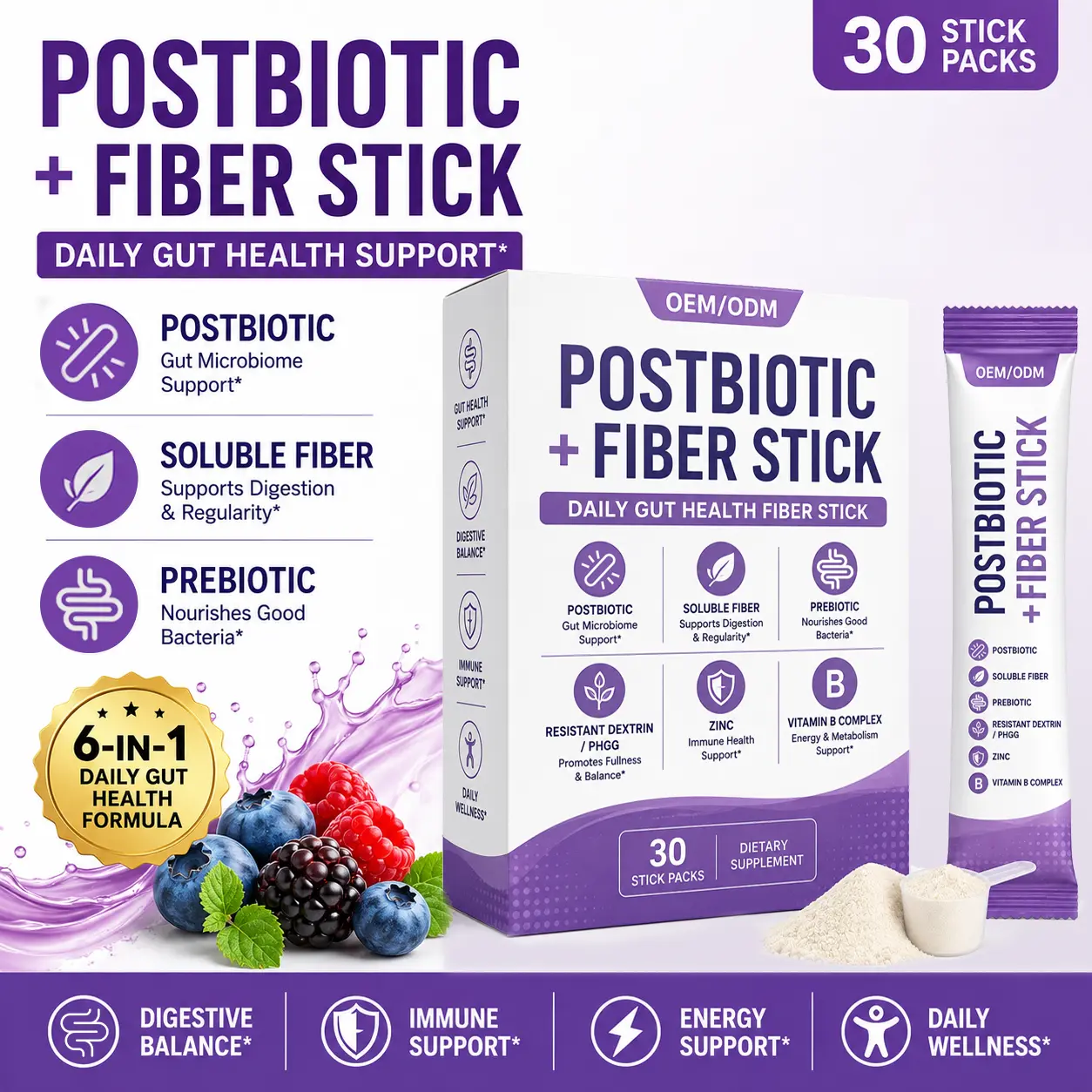
- Powder stick products
- Capsules and tablets
- Protein and nutrition formulas
- Products combining postbiotics with prebiotic fiber
- Specialized healthy-aging and wellness formulations
The purpose is not simply to replace probiotics. Instead, postbiotics provide another ingredient category that can be considered when developing stable, convenient, and research-based functional products.
Key Benefits of Postbiotics
1. Stability Without Live Microorganisms
One of the main advantages of postbiotics is that their functionality does not depend on keeping microorganisms alive throughout the product's shelf life.
This can simplify certain formulation challenges associated with probiotic products. Recent reviews highlight the potential of postbiotics for food systems where thermal processing, storage, and transportation stability are important considerations.
However, “stable” does not mean that every postbiotic is stable under every condition. Temperature, moisture, oxygen, pH, packaging, processing, and interactions with other ingredients can still affect the final product.
2. Flexible Formulation Potential
Postbiotics can be incorporated into different types of formulations, giving product developers more flexibility when creating functional nutrition products.
Depending on the specific postbiotic preparation and its technical specifications, it may be considered for powders, capsules, functional beverages, dairy products, nutrition mixes, and other food or supplement formats. Research continues to investigate delivery systems and ways to maintain postbiotic functionality in different food matrices.
3. Suitable for Convenient Product Formats
Because postbiotics do not require live-cell viability as their defining feature, they can be attractive for convenient formats such as powder sticks and dry mixes.
These formats are particularly useful for products intended for daily consumption because they can combine the postbiotic ingredient with other functional powders such as fiber, protein, botanical extracts, vitamins, minerals, or other nutritional ingredients.
4. Compatibility With Functional Food Development
Postbiotics are being investigated for applications beyond traditional supplement capsules. Research has examined their use in different food systems, including dairy and other functional food applications.
This gives manufacturers more opportunities to develop products positioned around everyday nutrition rather than relying only on conventional probiotic supplements.

Postbiotics for Gut and Digestive Health Products
Gut and digestive health is one of the most important application areas for postbiotic ingredients.
Postbiotic research includes microbial components and metabolites that may interact with biological pathways associated with the gastrointestinal environment. However, the effects are not automatically the same for every postbiotic. The specific microorganism, preparation, dose, manufacturing method, and research evidence all need to be considered when evaluating an ingredient.
For product developers, this means that a postbiotic should be selected based on its specific research and technical characteristics, rather than treating all postbiotics as interchangeable.
Potential product applications include:
Daily digestive wellness powders
Gut health capsules
Functional fiber blends
Digestive support drink mixes
Functional yogurt and dairy products
Ready-to-drink nutrition products
Postbiotic and prebiotic combinations
Postbiotics + Prebiotic Fiber
One practical formulation concept is combining postbiotics with prebiotic fiber.
Postbiotics provide microbial-derived functional components, while prebiotic fibers are used as substrates that can be selectively utilized by microorganisms. These are different ingredient categories with different functions, so combining them should be based on the intended formulation and available evidence rather than assuming a proven synergy.
For manufacturers, this combination can be developed into a broader digestive nutrition concept.
For example, a powder formulation could combine:
Postbiotic + Prebiotic Fiber + Plant Extract
or:
Postbiotic + Fiber + Protein
These concepts can be adapted for powder sticks, daily drink mixes, capsules, or other functional formats.
Postbiotics + Protein
Another application is combining postbiotics with protein-based nutrition.
Protein is widely used in sports nutrition, active nutrition, healthy-aging products, meal-support formulas, and everyday nutrition products. Adding a postbiotic can create a formulation that brings together nutritional and microbiome-related positioning.
For example:
Postbiotic + Protein + Prebiotic Fiber
can be developed as a powder intended for mixing into water, smoothies, shakes, or other functional beverages.
This type of combination is a formulation concept, rather than a clinically established three-ingredient treatment. Product developers should evaluate each ingredient and the finished combination separately.
Applications of Postbiotics
Powder Supplements
Powder is one of the most flexible formats for postbiotic ingredients.
A powdered postbiotic can be incorporated into single-serve sachets, tubs, functional drink powders, nutrition blends, and customized powder formulas.
Powder formulations may also allow brands to combine postbiotics with:
Prebiotic fiber
Protein
Vitamins and minerals
Botanical extracts
Amino acids
Electrolytes
Other functional ingredients
Powder Stick Applications
Powder sticks are useful for brands looking to create portable, single-serving products.
A postbiotic stick can be designed as a daily drink mix, digestive wellness formula, functional nutrition product, or combination formula.
A concept could include:
Postbiotic + Prebiotic Fiber
or:
Postbiotic + Protein + Fiber
The final formula can be adjusted according to dosage, flavor, solubility, moisture sensitivity, packaging requirements, and target product format.
Capsules and Tablets
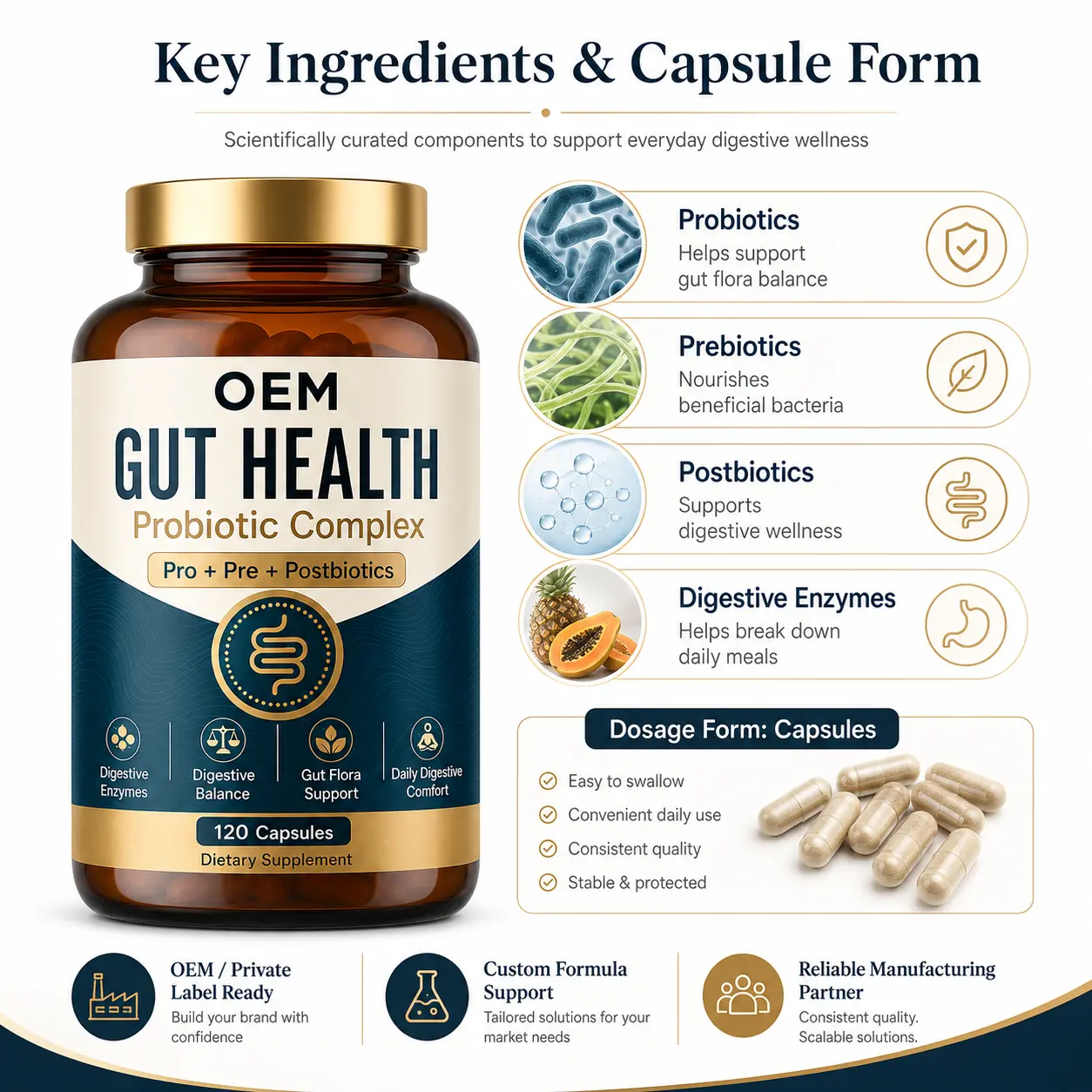
Capsules remain a practical format for concentrated ingredient delivery.
Postbiotics can be considered for standalone capsules or combination formulas containing other functional ingredients. This format is particularly suitable when the product developer wants a convenient, measured serving without requiring preparation.
Functional Beverages
Postbiotics can also be explored in functional beverage formulations.
Potential applications include:
Functional water
Wellness drinks
Nutrition beverages
Protein beverages
Fiber drinks
Dairy-based functional drinks
Plant-based beverages
For beverage development, manufacturers need to consider pH, heat treatment, solubility, sedimentation, flavor, packaging, and stability during the intended shelf life.
Recent reviews emphasize that interactions between postbiotics and food matrices remain an important area of formulation research.
Ready-to-Drink Products
RTD products provide another potential application for postbiotic ingredients.
A ready-to-drink formula may combine a postbiotic with protein, fiber, botanical ingredients, vitamins, minerals, or other functional components.
However, RTD processing can expose ingredients to heat, oxygen, changes in pH, and extended storage. Therefore, the suitability of a specific postbiotic should be confirmed through finished-product stability testing rather than assumed from the ingredient's raw-material stability.
Postbiotics for Functional Food Applications
Postbiotics are also being explored beyond traditional dietary supplements.
Food manufacturers can investigate their use in products such as:
Dairy and fermented products:
Postbiotics can be incorporated into certain dairy and functional food concepts where stability and processing performance are important.
Nutrition powders:
Postbiotics can be combined with protein, fiber, vitamins, minerals, or other functional ingredients.
Beverages:
Postbiotics can be considered for functional drinks, nutrition beverages, and powdered beverage mixes.
Daily wellness products:
Postbiotics can be positioned as part of broader digestive or functional nutrition formulations.
Research published in 2026 highlights the expanding food applications of postbiotics while also noting the importance of standardized production, characterization, food-matrix compatibility, and regulatory considerations.
Why Postbiotics Are Interesting for Product Developers
The main attraction of postbiotics is not simply that they are “the next probiotics.” Their value comes from the combination of microbial-derived functionality and formulation flexibility.
For manufacturers, this can mean exploring products where maintaining live microorganisms is not the primary requirement.
Postbiotics may therefore fit into product development strategies focused on:
Stability
Convenient formats
Functional food applications
Powder formulations
Combination formulas
Long-distance transportation
Room-temperature products, where supported by ingredient-specific stability data
Shelf-life management
At the same time, product developers should avoid assuming that all postbiotic ingredients have the same stability or health effects. Current research continues to identify differences between preparations and highlights the need for standardized characterization and clinical validation.
Choosing a Postbiotic Ingredient
For B2B buyers, the quality of the raw material is just as important as the concept of the finished product.
When sourcing a postbiotic, manufacturers should review:
Microbial source and strain
Production method
Inactivation method
Active or functional components
Standardization information
Recommended dosage
Storage conditions
Shelf life
Stability data
Microbiological specifications
Heavy metal and contaminant testing
COA and technical documentation
Existing research on the specific preparation
The research should also be matched to the actual ingredient being purchased. Evidence from one postbiotic preparation should not automatically be transferred to a different preparation.
Postbiotics as a Ingredient Opportunity
The growing interest in postbiotics creates opportunities for manufacturers developing new functional food and supplement products.
Instead of using postbiotics only as a standalone ingredient, brands can explore combination formulas based on their target market and finished-product format.
Examples include:
Digestive Daily Formula
Postbiotic + Prebiotic Fiber
Protein Gut Nutrition
Postbiotic + Protein + Prebiotic Fiber
Daily Wellness Powder
Postbiotic + Fiber + Botanical Extract
Functional Beverage Formula
Postbiotic + Fiber + Vitamins + Minerals
Healthy Aging Nutrition
Postbiotic + Protein + Fiber + Selected Nutritional Ingredients
These are formulation concepts for product development. The final composition, dosage, claims, and application should be determined according to ingredient-specific evidence, technical requirements, and applicable regulations.
Yangge Biotech: Postbiotic and Powder Ingredient Supply
For brands and manufacturers developing functional foods, dietary supplements, and nutrition products, sourcing the right powder ingredients is an important part of formulation development.
Yangge Biotech provides powder ingredients for B2B applications, including postbiotic ingredients as well as other functional powders, botanical extracts, nutraceutical ingredients, food ingredients, and beverage ingredients.
For product development projects, ingredient documentation such as specifications, COA, TDS, MSDS, samples, and quotations can support the evaluation and sourcing process.
Postbiotic ingredients can also be considered for customized formulation projects, including powder sticks, functional powders, capsules, beverages, and other product formats depending on the technical requirements of the finished product.
Conclusion
Postbiotics are becoming an increasingly interesting ingredient category for functional food and dietary supplement development because they offer a different approach from live probiotics.
Their main purpose is to provide functional microbial-derived preparations without depending on live microorganism viability. This can create opportunities for more flexible applications across powders, capsules, beverages, dairy products, and other functional foods.
For manufacturers, the most important point is that postbiotics should be evaluated as specific preparations, not as one interchangeable ingredient category. Stability, composition, processing conditions, dosage, research evidence, and finished-product performance all need to be considered.
As research and food-technology development continue, postbiotics can provide another option for brands looking to develop stable, convenient, and research-informed functional nutrition products.
Contact Yangge Biotech today to request product specifications, COA, samples, pricing, or OEM/ODM manufacturing solutions for exclusive postbiotic powder ingredients.
Email: info@yanggebiotech.com
Frequently Asked Questions
What is the main purpose of postbiotics?
The main purpose of postbiotics is to provide functional microbial-derived preparations without requiring the microorganisms to remain alive. This makes them a potential ingredient option for functional foods, beverages, and dietary supplements.
What is the main benefit of postbiotics?
One of the main potential benefits is formulation flexibility. Because postbiotics do not rely on live-cell viability, they can be considered for applications where processing and storage stability are important.
Can postbiotics be used in powder products?
Yes. Postbiotics can be explored in powder supplements, drink mixes, powder sticks, nutrition powders, and combination formulas. The suitability of a specific ingredient depends on its technical specifications and stability data.
Can postbiotics be combined with prebiotic fiber?
Yes. Postbiotic and prebiotic fiber combinations are a potential formulation concept for digestive and functional nutrition products. However, the combination should be evaluated based on the specific ingredients and available evidence.
Can postbiotics be used in beverages?
Yes. Postbiotics can be explored in functional beverages and RTD products. Developers should evaluate factors such as pH, processing temperature, solubility, packaging, storage conditions, and finished-product stability.
Are postbiotics the same as probiotics?
No. Probiotics are live microorganisms that provide a health benefit when administered in adequate amounts. Postbiotics are non-living preparations that meet the established criteria for the postbiotic category.
Are all postbiotics equally stable?
No. Stability depends on the specific preparation, manufacturing process, composition, dosage form, packaging, and storage conditions. Current research emphasizes the need for preparation-specific characterization and stability evaluation.
Can Yangge Biotech supply postbiotic powder ingredients?
Yangge Biotech focuses on B2B powder ingredient supply and can support product developers looking for postbiotic and other functional powder ingredients for food, beverage, dietary supplement, and nutraceutical applications.
References
Salminen, S., Collado, M. C., Endo, A., et al. (2021). The International Scientific Association for Probiotics and Prebiotics (ISAPP) consensus statement on the definition and scope of postbiotics. Nature Reviews Gastroenterology & Hepatology.
Taspinar, T., & Güzeler, N. (2026). Postbiotics in Food Systems: Components, Production Methods, Food Applications, Functional Properties, and Technological Challenges. Food Science & Nutrition.
Postbiotics in the food industry: applications, delivery systems, and future perspectives. (2025/2026). PubMed.
Postbiotics in Dairy: A Comprehensive Review of Applications and Health Impacts. (2026). PubMed.

Send Inquiry
Related Industry Knowledge
Recommended Products