Is Gardenia Blue Heat Stable Compared to Blue Spirulina
Yangge Biotech Co., Ltd. supplies premium Gardenia Blue and Blue Spirulina Powder for the food, beverage, nutraceutical, and confectionery industries. Manufactured under strict quality control, our natural blue colorants offer consistent quality, reliable performance, and stable bulk supply to meet diverse formulation requirements. In this article, we'll compare the heat stability, processing performance, applications, and advantages of Gardenia Blue and Blue Spirulina to help manufacturers select the most suitable natural blue color for their products.
In East Asia, companies that process food, make supplements for sale, and make traditional Chinese medicine preparations all have to deal with the same problem: most natural blue colorants fade, change color, or break down completely when they are heated for production. One thing that makes Gardenia Blue different from other natural blue pigments is how it works in a retort, pasteurizer, or extrusion line. Yangge Biotech's E165-gardenia-blue is based on three main strengths that matter most to large-scale manufacturers: it is very stable in both high and low temperatures and pH levels; it is significantly cheaper when produced with gardenia yellow; and it has been a leading natural blue choice across East Asian regulatory frameworks for many years.
Why Is Heat Stability Important For Natural Blue Food Colors?
Heat stability tells us if a natural blue colorant stays blue during the manufacturing process or if it fades, turns brown, or turns green before the product even gets to the store shelves. This is very important for East Asian food processors who use retort sterilization, UHT beverage lines, or baking processes, because an unstable colorant means that they have to spend a lot of money on reformulating or overdosing to make up for the expected loss. Many makers chose Gardenia Blue because it works well in high-volume, demanding environments where cheaper natural blue colors usually fail.
Why blue pigments are chemically harder to stabilize than other natural colors
Because blue natural colorants depend on chromophore structures that are more sensitive to heat than red or yellow ones, there aren't many choices on the market that are truly heat-stable.
The cost of colorant failure during high-volume manufacturing
Manufacturers either throw away the batch, over-formulate to make up for it, or accept a finished product that isn't uniform when a colorant fades in the middle of the process. All of these options cut into their profit margins over time.
Consumer expectations for consistent color across product batches
More and more, retail buyers and foreign customers are rejecting packages where color differences can be seen. This means that batch-to-batch steadiness is no longer just a technical choice, but a business necessity.
How processing method determines the real-world stability requirement
When a colorant goes through retort sterilization, UHT treatment, baking, or extrusion, it is exposed to different amounts of heat, time, and moisture. Because of this, manufacturers need stability data that is specific to their process, not just general marketing claims.
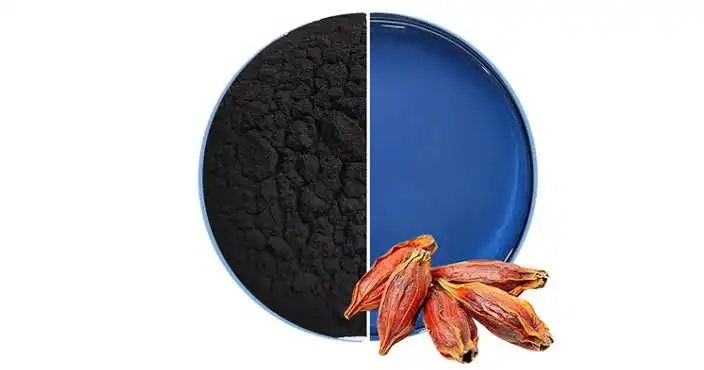
How Does Gardenia Blue Compare With Blue Spirulina During Heat Processing?
When real processing heat comes into play, Gardenia Blue always does better than blue spirulina. This is the main difference that East Asian food processors look at when choosing between the two. Blue spirulina, which comes from phycocyanin, is known for having a bright color when it is cold or lightly processed. However, its color fades quickly at high temperatures and becomes less noticeable after being exposed to heat for a long time. E165-gardenia-blue, on the other hand, was created and quickly spread through East Asian markets because it keeps its color much better after being pasteurized, retort processed, and baked.
|
Processing Condition |
Gardenia Blue Performance |
Blue Spirulina Performance |
|
Pasteurization (short exposure) |
Minimal color loss |
Noticeable fading begins |
|
Retort sterilization (sustained high heat) |
Retains usable color intensity |
Significant to severe degradation |
|
Baking/extrusion |
Stable through typical bake cycles |
Generally unsuitable, rapid loss |
|
Cold or lightly processed applications |
Performs well |
Performs well, comparable to gardenia blue |
Phycocyanin's heat sensitivity and its formulation limitations
Blue spirulina's phycocyanin pigment is a protein-based colorant, and proteins are inherently more prone to heat-induced structural breakdown than the compound class behind gardenia blue.
Gardenia blue's chemical stability advantage under sustained heat
Gardenia blue's iridoid-derived pigment structure holds up far better under sustained thermal exposure, which is why it remains a preferred choice for retort and UHT-processed products across the region.
Real-world processing scenarios where the difference becomes obvious
Manufacturers running high-temperature short-time pasteurization or full retort sterilization typically notice the performance gap immediately, often after an initial trial run with blue spirulina fails to hold color.
Why this comparison matters most for export-oriented manufacturers
Export supplement and food brands shipping products across long distances and variable climates need a colorant that has already proven itself stable through worst-case heat exposure during both manufacturing and transit.
What Temperatures Can Gardenia Blue Withstand Without Significant Color Loss?
Gardenia Blue demonstrates reliable color retention across the temperature ranges commonly used in food and beverage manufacturing, including standard pasteurization and many retort sterilization protocols. This performance window is a major reason East Asian food processors and TCM preparation manufacturers rely on gardenia blue color for products that must survive thermal processing without a visible shift in hue or intensity. While exact retention figures vary by matrix, pH, and exposure duration, gardenia blue's general thermal tolerance profile places it well ahead of most other natural blue alternatives on the market today.
Typical pasteurization temperature performance
Standard pasteurization cycles, generally in the 70 to 95 degrees Celsius range for short durations, cause only minimal visible color change in properly formulated gardenia blue applications.
Sustained high-heat exposure during retort sterilization
Retort sterilization, which combines higher temperatures with longer hold times, is a more demanding test, and gardenia blue's structural stability allows it to retain usable color intensity where many alternatives would fully degrade.
Baking and extrusion temperature considerations
Dry-heat applications like baking and extrusion introduce a different stress profile than wet-heat processing, and gardenia blue has demonstrated dependable performance across typical commercial baking temperature and time combinations.
Factors that influence real-world thermal performance in finished products
Actual color retention depends on formulation pH, moisture content, exposure duration, and packaging protection from light, so manufacturers should always validate performance within their specific process rather than relying on temperature figures alone.
.webp?size=837x0 "yangge Biotech Gardenia Blue Extract stability")
Should Manufacturers Choose Gardenia Blue Or Blue Spirulina For High-temperature Processing?
For any application involving genuine high-temperature processing, Gardenia Blue is the more reliable choice over blue spirulina, and this is increasingly the default recommendation among East Asian food processors and export supplement manufacturers who have already tested both options. Blue spirulina remains a reasonable choice for cold-processed or minimally heated applications where its vivid, clean blue hue is a genuine advantage, but once retort sterilization, baking, or extended pasteurization enters the process, E165-gardenia-blue becomes the more dependable and cost-effective option.
Decision framework based on processing temperature and duration
Manufacturers should map their actual process conditions, temperature, duration, and pH, against each colorant's known performance profile before committing to a formulation direction.
Matching colorant choice to product shelf life expectations
Products with longer shelf life requirements benefit from gardenia blue's superior stability, since color degradation often continues slowly even after initial processing is complete.
Considering total formulation cost alongside performance
Because gardenia blue is co-produced alongside gardenia yellow, manufacturers frequently find a meaningful cost advantage compared to blue spirulina, particularly at the production volumes common among East Asian food processors.
Why many manufacturers ultimately standardize on gardenia blue
Once a manufacturer experiences the practical difference between the two colorants under real production heat, most standardize on gardenia blue for any application involving meaningful thermal processing.
Which Food And Beverage Applications Require A Heat-stable Natural Blue Color?
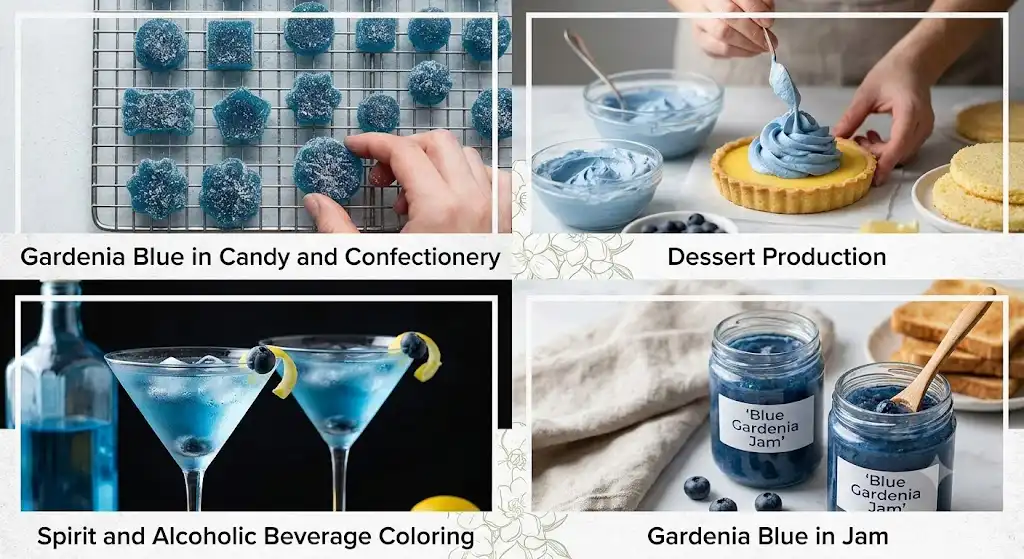
Several high-volume product categories depend specifically on a heat-stable natural blue colorant, and Gardenia Blue has become a standard choice across many of them precisely because of its processing resilience. Candy and confectionery manufacturing, dessert production, spirit and alcoholic beverage coloring, and jam or preserve manufacturing all involve heat exposure at some stage, making colorant stability a functional requirement rather than a cosmetic preference.
Candy and confectionery manufacturing heat exposure
Hard candy and gummy production both involve cooking sugar syrups at elevated temperatures, conditions under which gardenia blue color retains far more visual intensity than heat-sensitive alternatives.
Dessert production and baking-related thermal stress
Baked and heat-set desserts require a colorant that survives oven temperatures without browning or fading, an area where gardenia blue has become a common formulation standard.
Spirit and alcoholic beverage coloring requirements
Alcoholic beverages, including spirits and flavored liqueurs, sometimes involve pasteurization or flash-heating steps, and gardenia blue's stability across varying pH and alcohol content makes it a practical fit.
Jam, preserve, and fruit-based product processing
Jam and preserve manufacturing typically involves prolonged boiling, a processing condition where gardenia blue's heat tolerance provides a clear advantage over more fragile natural blue pigments.
What Role Does Ph Stability Play In Gardenia Blue Color Performance?
Beyond heat, Gardenia Blue also demonstrates strong stability across a range of pH conditions, which matters significantly for East Asian food processors formulating acidic beverages, fermented products, or traditional preparations with variable pH profiles. This dual stability, heat and pH together, is part of why E165-gardenia-blue has earned its compliance leadership position across East Asian markets, where formulators need one dependable colorant that performs consistently across diverse product categories rather than requiring different pigments for different pH ranges.
How pH shifts affect natural blue colorant performance generally
Many natural blue pigments shift toward green, purple, or lose color intensity entirely as pH moves away from neutral, creating formulation headaches for acidic products.
Gardenia blue's comparative pH tolerance range
Gardenia blue maintains a more consistent hue across a broader pH range than many alternative natural blue colorants, reducing the need for pH-specific reformulation.
Formulating for acidic beverages and fermented applications
Acidic beverages and fermented food products benefit particularly from gardenia blue's pH resilience, since these categories often see the most dramatic color shifts with less stable colorants.
Combined heat and pH stability as a formulation simplification
Having one colorant that performs reliably across both heat and pH conditions reduces formulation complexity and testing time for manufacturers developing multiple product lines simultaneously.
What Cost Advantages Does Gardenia Blue Offer Through Co-production With Gardenia Yellow?
One of the most commercially relevant advantages of Gardenia Blue for East Asian food processors and export supplement manufacturers is its cost structure, driven largely by co-production alongside gardenia yellow from the same raw material stream. This shared extraction process allows suppliers like Yangge Biotech to offer gardenia blue color at a more competitive price point than colorants requiring entirely separate cultivation and extraction infrastructure, such as blue spirulina.
|
Cost Factor |
Gardenia Blue |
Blue Spirulina |
|
Raw material source |
Shared with gardenia yellow co-production |
Dedicated spirulina cultivation |
|
Extraction infrastructure |
Leveraged across both pigment streams |
Standalone processing required |
|
Typical cost positioning |
More cost-efficient at scale |
Generally higher input cost |
|
Supply chain complexity |
Streamlined through shared processing |
Separate supply chain required |
How co-production with gardenia yellow reduces raw material cost
Extracting both gardenia yellow and gardenia blue from the same processing stream allows raw material and processing costs to be distributed across two commercial products rather than one.
Comparing total cost of ownership against blue spirulina sourcing
When manufacturers factor in stability-related waste, reformulation costs, and raw material pricing together, gardenia blue frequently delivers a lower total cost of ownership than blue spirulina.
Scaling cost advantages at high production volumes
The cost benefit of co-production becomes more pronounced at higher production volumes, which is particularly relevant for East Asian food processors and export supplement manufacturers running large-scale operations.
Balancing cost efficiency with regulatory compliance value
Beyond raw cost, gardenia blue's established compliance history across East Asian markets reduces regulatory risk and approval timelines, adding further value beyond the price advantage alone.
What Should East Asian Food Processors And Tcm Manufacturers Verify When Sourcing E165-gardenia-blue?
Buyers sourcing E165-gardenia-blue for food processing, export supplement production, or traditional Chinese medicine preparation should verify heat and pH stability data specific to their application, confirm co-production sourcing transparency, and check regulatory documentation relevant to their target export markets. Yangge Biotech supports all three through documented stability testing, transparent sourcing practices, and a compliance track record built specifically around East Asian regulatory frameworks.
Requesting application-specific stability testing data
Buyers should request stability data reflecting their actual processing conditions rather than relying on general marketing claims about heat or pH tolerance.
Confirming sourcing transparency and co-production traceability
Traceable sourcing documentation, connecting the raw material back to its co-production origin with gardenia yellow, helps buyers verify both quality consistency and the cost advantage claimed by the supplier.
Reviewing regulatory compliance documentation for target markets
TCM preparation manufacturers and export supplement brands should confirm that regulatory documentation aligns with their specific target markets, since compliance requirements vary across East Asian jurisdictions.
Evaluating supplier certifications and quality management systems
Certifications such as ISO, HACCP, Kosher, and Halal provide additional assurance of consistent quality management practices behind the colorant supply.
Gardenia Blue Powder Specifications
|
Product name |
Gardenia blue powder |
|
Other name |
Gardenia blue powder extract |
|
Appearance |
Dark blue fine powder |
|
Source |
Gardenia Jasminoides Ellis |
|
Solubleness |
100% water soluble |
|
PH |
4.0-8.0 |
|
Application |
Natural food grade colorant |
Gardenia Blue Powder COA
|
Item |
Standard |
Test Result |
Test Method |
|
Appearance |
Blue fine powder |
Conform |
Visual |
|
Particle Size |
90% over 200 mesh |
Conform |
80 mesh screen |
|
Solubility |
100% soluble in water |
Conform |
Visual |
|
Moisture Content |
≤5.0% |
3.9% |
5g / 105°C / 2hrs |
|
Ash Content |
≤5.0% |
3.08% |
2g / 525°C / 3hrs |
|
Heavy Mental |
≤ 20ppm |
Conform |
Atomic absorption method |
|
As |
≤ 2ppm |
Conform |
Atomic absorption method |
|
Pb |
≤ 2ppm |
Conform |
Atomic absorption method |
|
Pesticide Residues |
≤0.1ppm |
Conform |
Gas chromatography |
|
Sterilization Method |
High temperature, high pressure |
Conform |
|
|
Total Bacteria Count |
≤1000cfu/g |
Conform |
|
|
Total Yeast Count |
≤100cfu/g |
Conform |
|
|
E. Coli |
Negative |
Conform |
|
|
Salmonella |
Negative |
Conform |
|
|
Staphylococcus |
Negative |
Conform |
Quality assurance is one of Yangge Biotech's highest priorities. Every batch of Gardenia Blue Powder is accompanied by a third-party test report that verifies product purity, active ingredient content, heavy metals, pesticide residues, microbiological safety, and other critical quality parameters. Independent laboratory testing ensures that every shipment meets international quality standards and provides customers with confidence in product consistency and safety.
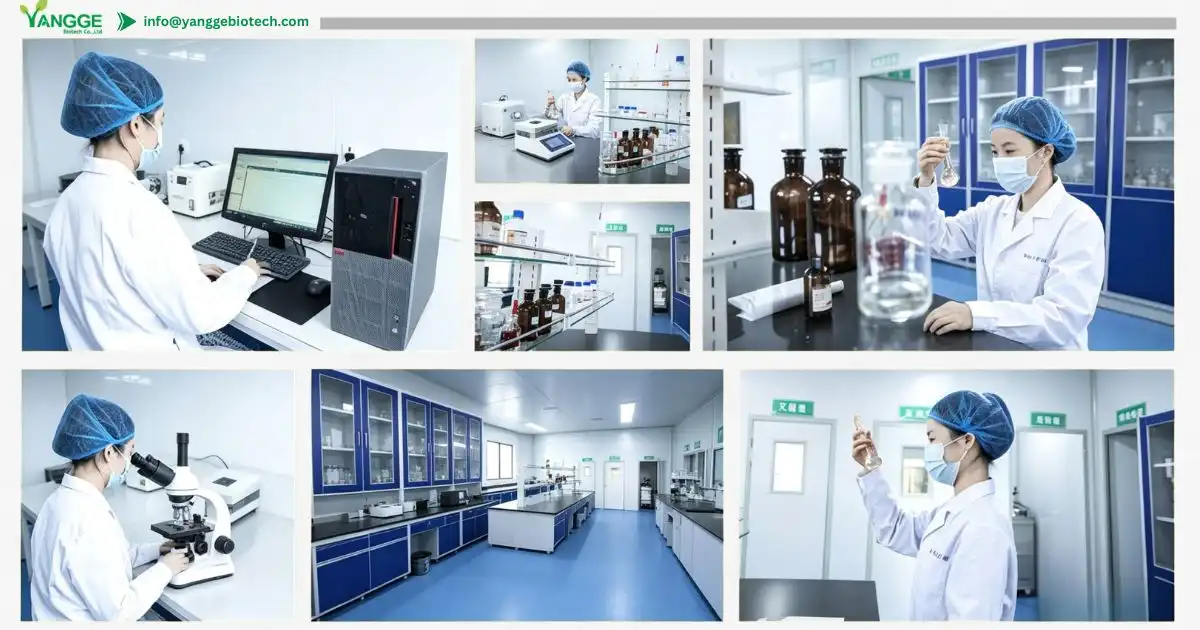
R&D Capacity
Yangge Biotech has a professional research and development team dedicated to botanical extracts and nutraceutical ingredients. Our R&D department continuously optimizes extraction techniques, purification processes, formulation development, and quality control methods. Equipped with advanced analytical instruments and experienced scientists, we are capable of developing customized Gardenia Blue Powder specifications and providing technical support for new product development, helping customers create innovative and competitive health products.
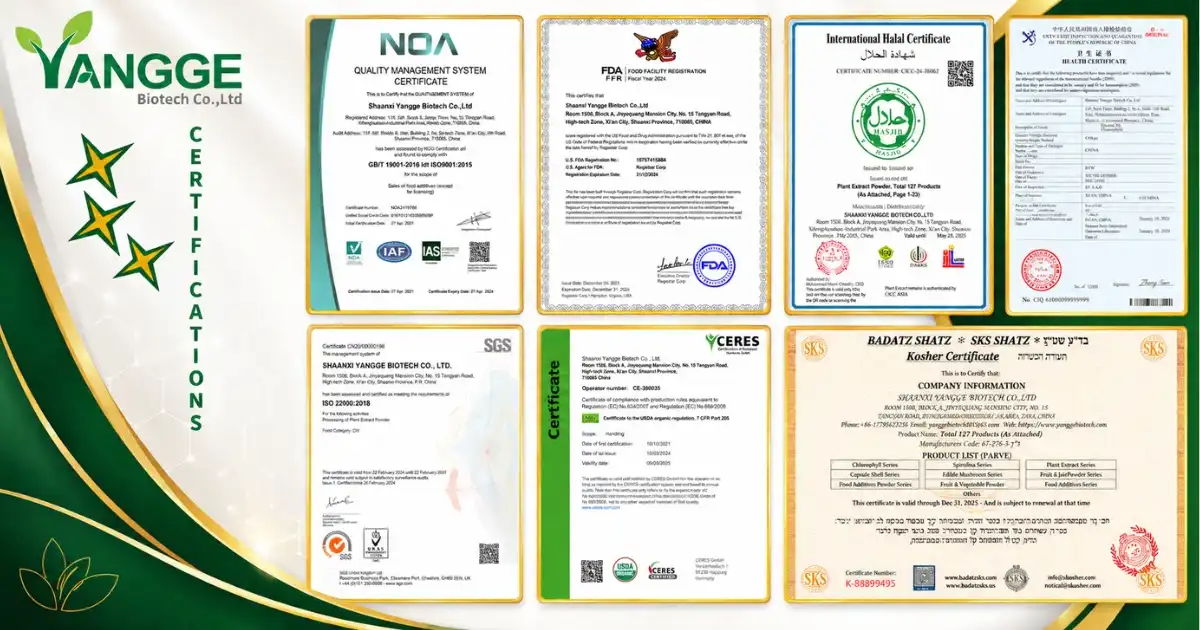
Certificates
Yangge Biotech operates under internationally recognized quality management systems to ensure consistent product quality and safety. Depending on customer requirements and market regulations, our products can be supplied with certifications such as GMP, ISO, HACCP, Halal, Kosher, and other relevant documentation. These certifications demonstrate our commitment to manufacturing excellence, regulatory compliance, and global market acceptance.
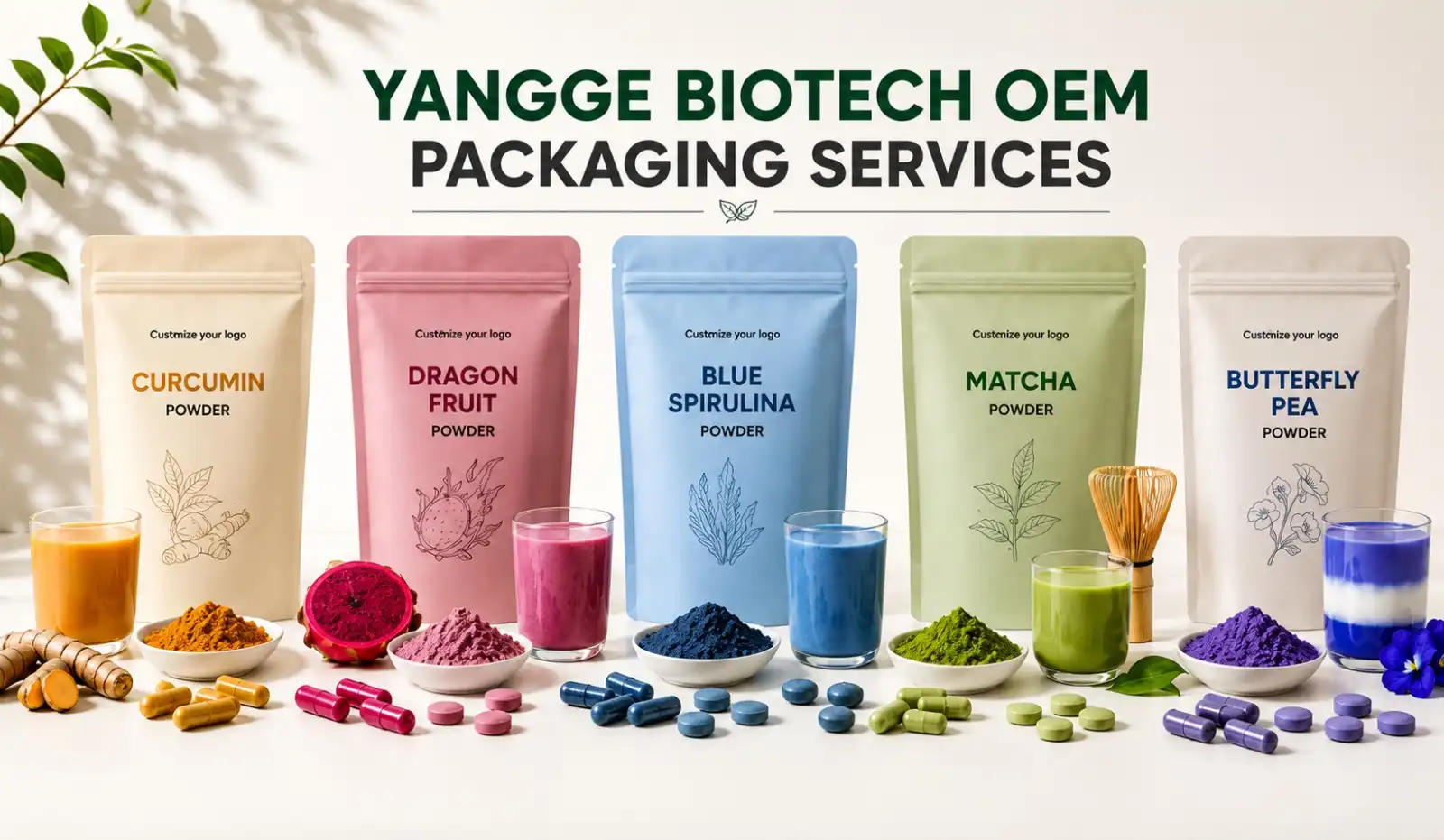
OEM Packing
Yangge Biotech offers comprehensive OEM and private-label packaging services tailored to customer needs. We provide bulk packaging for industrial users as well as customized retail packaging options, including bottles, pouches, cartons, labels, and branded packaging solutions. Our experienced team assists with package design, labeling, and product customization, enabling customers to launch their own berberine products efficiently and professionally.
Why Choose Yangge Biotech?
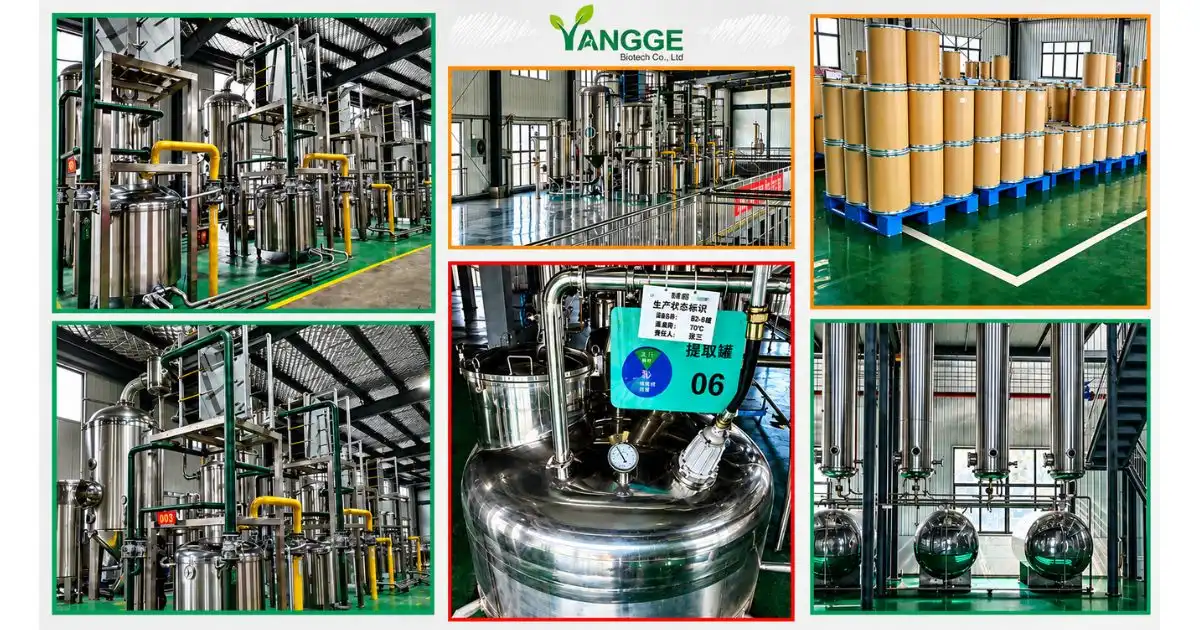
Yangge Biotech is a trusted supplier of premium botanical extracts with years of manufacturing experience. We offer high-purity Gardenia Blue Powder, strict quality control throughout production, third-party testing for every batch, competitive pricing, stable global supply, customized product specifications, professional technical support, fast delivery, and reliable OEM services. Our commitment to quality, innovation, and customer satisfaction makes us a dependable partner for businesses worldwide.
Conclusion
Gardenia Blue offers meaningfully better heat and pH stability than blue spirulina, making it the more dependable choice for candy, desserts, spirits, and jams that undergo real thermal processing. Combined with its cost advantage from gardenia yellow co-production and its established East Asian compliance leadership, E165-gardenia-blue gives food processors, export brands, and TCM manufacturers a natural blue colorant built for demanding production environments.
FAQ
Q1: Does gardenia blue fade during retort sterilization?
Gardenia blue retains significantly more color intensity than blue spirulina under retort sterilization, though some gradual change is expected with any natural colorant under sustained high heat.
Q2: Is gardenia blue more expensive than blue spirulina?
Gardenia blue is generally more cost-efficient due to co-production alongside gardenia yellow, which shares raw material and processing infrastructure.
Q3: Can gardenia blue be used in acidic beverage formulations?
Yes, gardenia blue demonstrates strong pH stability, making it suitable for acidic beverages where many other natural blue colorants shift hue or fade.
Q4: Which is better for baked goods, gardenia blue or blue spirulina?
Gardenia blue is generally better suited to baked goods since it withstands oven temperatures more reliably than heat-sensitive blue spirulina.
Q5: Is gardenia blue approved for use across East Asian markets?
Gardenia blue has an established compliance history across multiple East Asian regulatory frameworks, though manufacturers should always confirm current approval status for their specific target market.
Partner With Yangge for Heat-Stable Natural Blue Coloring
If your production line involves retort sterilization, baking, extrusion, or any other high-heat process, choosing the right natural blue colorant can be the difference between a consistent, shelf-ready product and a costly reformulation cycle. Yangge Biotech Co., Ltd. focuses on natural plant extracts for food and beverages, dietary supplements, and super food, and we are proud to be ISO, HACCP, Kosher, and Halal certified. Our dedicated R&D and production teams, supported by 24-hour online service, are ready to help you match Gardenia Blue to your specific processing conditions, whether you're coloring candy, desserts, spirit-based beverages, or jams and preserves.
Our E165-gardenia-blue combines outstanding heat and pH stability with a genuine cost advantage from co-production alongside gardenia yellow, backed by a compliance track record that has made us a trusted natural blue supplier across East Asian markets for years. With sustainable sourcing developed alongside our farming community partners and a stable export supply chain reaching customers across many countries, we help food processors, export supplement brands, and traditional preparation manufacturers source with confidence.
Our team works closely with every client to understand specific formulation needs and deliver personalized solutions built around strict purity, potency, and quality standards. Good health starts with good ingredients, and we believe every product deserves a colorant that performs as reliably in the factory as it looks on the shelf. Reach out to our team today at info@yanggebiotech.com to request samples, stability data, or a formulation consultation, and let's bring your next Gardenia Blue application to life with Yangge.
References
1. Newsome, A.G., et al., "Blue Pigments from Natural Sources: Chemistry and Stability," Journal of Agricultural and Food Chemistry.
2. Buchweitz, M., "Natural Solutions for Blue Colors in Food," in Handbook on Natural Pigments in Food and Beverages, Woodhead Publishing.
3. Jespersen, L., et al., "Heat and Light Stability of Three Natural Blue Colorants for Use in Confectionery and Beverages," Food Chemistry.
4. Martins, N., et al., "Food Colorants: Challenges, Opportunities and Current Desires of Agro-Industries to Ensure Consumer Expectations and Regulatory Practices," Trends in Food Science and Technology.
5. Fu, R., et al., "Stability of Gardenia Blue Pigment Under Different Processing Conditions," Food Science and Biotechnology.
6. Chethana, S., et al., "Thermal Degradation Kinetics of Phycocyanin," Journal of Food Engineering.

Send Inquiry
Related Industry Knowledge
Recommended Products