Creatine for Women 40+: Exploring Creatine + Magnesium Glycinate + HMB
As women enter their 40s and beyond, nutrition priorities can change. Maintaining muscle, staying physically active, supporting recovery, and meeting daily nutritional needs can become increasingly important. At the same time, consumers are showing greater interest in convenient functional nutrition products designed around specific life stages and wellness goals.
One formulation concept gaining attention is the combination of creatine + magnesium glycinate + HMB (β-hydroxy-β-methylbutyrate). In Yangge Biotech's global nutraceutical trend report, this combination is positioned under the concept “Midlife Strength Daily,” with women 40+ as the target market and powder sticks or café-style mix-ins as potential product formats.
The three ingredients have different nutritional roles. Creatine is widely studied in relation to exercise performance, strength, and lean mass; magnesium is an essential mineral involved in muscle and nerve function and energy metabolism; and HMB is a metabolite of leucine that has been investigated for its potential role in muscle-related nutrition.
Importantly, the combination itself should be viewed as a formulation opportunity rather than a clinically established synergistic formula. Research on each ingredient is more extensive than research specifically testing creatine, magnesium glycinate, and HMB together.
Looking for the latest Creatine Powder 25 Ton price or a reliable bulk supplier? Contact Yangge Biotech today to request current pricing, COA, product specifications, samples, or OEM/ODM manufacturing solutions.
Email: info@yanggebiotech.com
What Is Creatine?
Creatine is a naturally occurring compound found primarily in skeletal muscle. The body produces creatine from amino acids, and dietary creatine is also obtained from foods such as meat and fish. Creatine is involved in the phosphocreatine system, which helps regenerate ATP, the body's immediate energy source during short-duration, high-intensity activity.
Because of this role, creatine monohydrate has become one of the most extensively studied ingredients in sports and active nutrition.
Creatine is traditionally associated with athletes and resistance training, but interest in creatine has expanded to other consumer groups, including adults interested in maintaining muscle and staying active as they age.
Recent research is particularly relevant to women after menopause. A 2026 systematic review and meta-analysis of seven randomized controlled trials involving 608 postmenopausal women found that creatine supplementation favored lean mass and leg-press strength, with the clearest benefits observed when creatine was combined with resistance training. The review did not find an overall improvement in bone mineral density.

This makes creatine an interesting ingredient for product developers exploring midlife and active-aging nutrition.
Mechanism of Action of creatine include:
Supporting the phosphocreatine energy system
Supporting high-intensity exercise performance
Supporting strength-oriented training
Supporting lean-mass-focused nutrition
Complementing resistance-training programs
Providing an ingredient platform for sports and active-aging formulas
Creatine should not, however, be presented as a replacement for resistance training, adequate protein, a balanced diet, or professional medical care.
Why Is Creatine Becoming Relevant to Women 40+?
The 40+ consumer segment is increasingly diverse. Women in this age group may include recreational exercisers, strength-training enthusiasts, busy professionals, active mothers, and consumers simply looking for convenient ways to maintain a healthy lifestyle.
From a product-development perspective, this creates an opportunity to move beyond traditional sports-nutrition positioning.
Instead of marketing creatine only as a “workout supplement,” brands can explore broader concepts such as:
Daily muscle-focused nutrition
Active-aging nutrition
Midlife wellness
Strength-training support
Convenient daily supplementation
Women-focused functional nutrition
Research in postmenopausal women provides a useful scientific foundation for this direction. The 2026 meta-analysis found small improvements in lean mass and leg-press 1RM with creatine, particularly when supplementation was paired with resistance training. (PubMed)
This does not mean every woman over 40 will experience the same response. Rather, it demonstrates why creatine is being investigated as part of nutrition strategies for women during and after the menopausal transition.
What Is Magnesium Glycinate?
Magnesium is an essential mineral involved in hundreds of biochemical reactions in the body. According to the U.S. National Institutes of Health Office of Dietary Supplements, magnesium contributes to protein synthesis, muscle and nerve function, energy production, and the regulation of calcium and potassium transport involved in muscle contraction.
Magnesium glycinate is a form of magnesium in which magnesium is associated with glycine. It is commonly used in dietary supplement formulations and is particularly suitable for products designed around daily wellness.
For a creatine-based midlife formula, magnesium provides a different nutritional dimension from creatine.
Magnesium's role in the formula can be positioned around:
Normal muscle function
Normal nerve function
Energy metabolism
Protein synthesis
Daily mineral nutrition
Complementary support for active lifestyles
However, it is important to distinguish magnesium's physiological role from claims about magnesium supplementation. A systematic review of magnesium supplementation and muscle fitness found that supplementation did not consistently improve muscle strength or power across studied populations, although benefits may be more relevant in people with inadequate magnesium status. (PubMed)
Therefore, the strongest formulation language is to describe magnesium as an essential nutrient with established physiological functions, rather than claiming that magnesium supplementation itself necessarily increases muscle strength.
What Is HMB?
HMB stands for β-hydroxy-β-methylbutyrate. It is a metabolite produced from leucine, an essential branched-chain amino acid.
HMB has been studied in sports nutrition and aging-related nutrition because of its potential relationship with muscle protein turnover and muscle preservation.
More recent evidence highlights why product claims should remain careful. A 2026 meta-analysis of 13 randomized controlled trials involving 561 adults aged 50 and older found no significant improvement in body composition or muscle strength when HMB was combined with resistance training. (PubMed)
As a result, HMB is best described as a research-backed muscle-nutrition ingredient with ongoing evidence development, rather than an ingredient with universally established benefits.
Why Combine Creatine + Magnesium Glycinate + HMB?
The concept behind the formula is not necessarily that the three ingredients have been proven to work synergistically. Instead, each ingredient can contribute a different nutritional function to a broader midlife strength and active-aging formulation.
1. Creatine — Exercise and Energy Support
Creatine provides the central active-nutrition component of the formula. Its established role in the phosphocreatine energy system makes it particularly relevant to resistance training and high-intensity exercise.
For women interested in strength training, creatine can therefore serve as the primary performance-oriented ingredient.
2. Magnesium Glycinate — Essential Mineral Nutrition
Magnesium adds an essential mineral component. It participates in muscle and nerve function, energy production, and protein synthesis. (Office of Dietary Supplements)
This allows the formula to move beyond a single-purpose sports supplement toward a more comprehensive daily nutrition concept.
3. HMB — Muscle-Focused Formulation Support
HMB adds another ingredient associated with muscle nutrition and muscle preservation research.
Although the evidence is not completely consistent, HMB remains an ingredient of interest for formulas targeting mature adults, active aging, and muscle-focused nutrition.
Together, these ingredients create a multi-component product concept that can be positioned around daily active nutrition rather than only pre-workout or post-workout use.
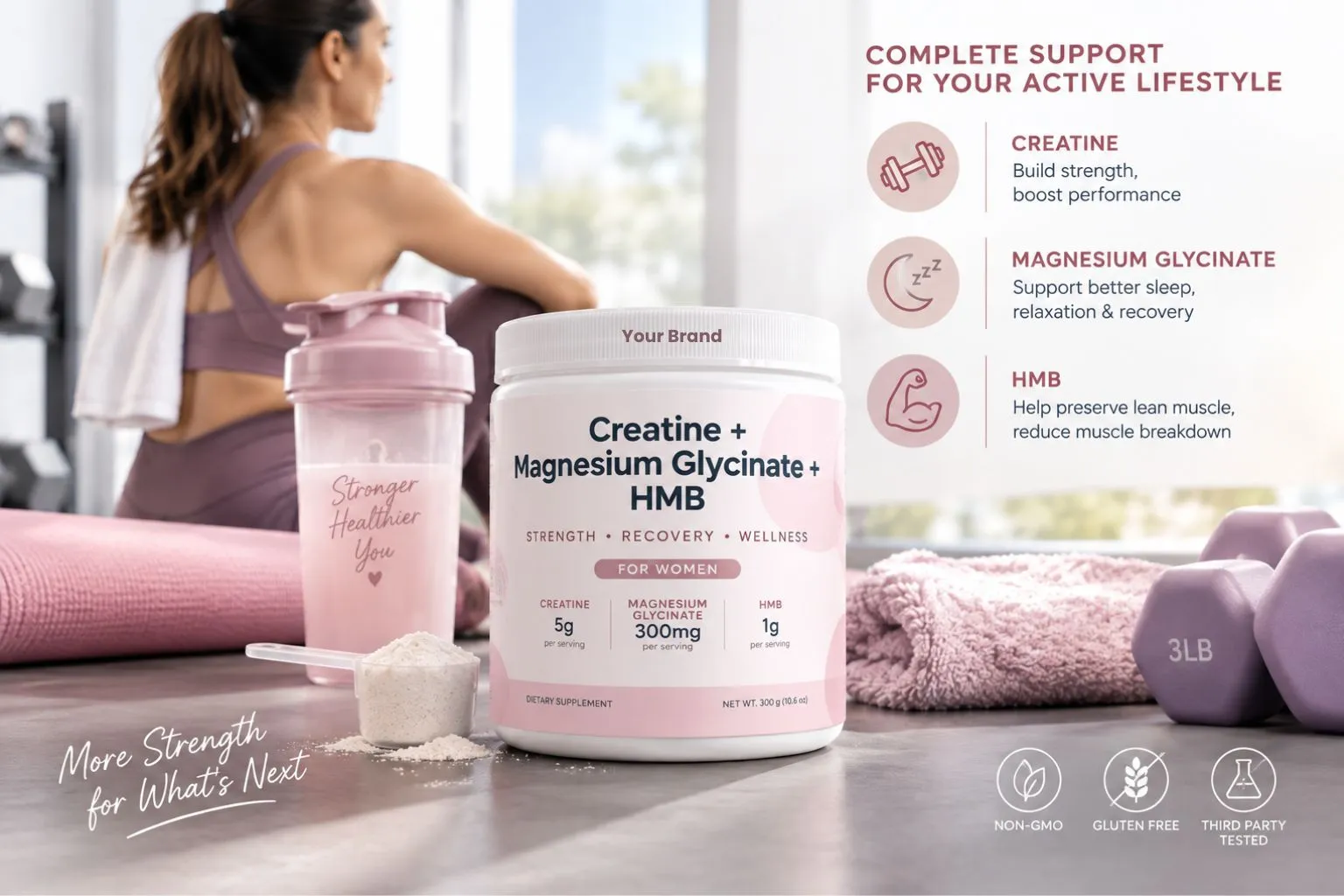
Creatine + Magnesium Glycinate + HMB for Midlife Nutrition
The “Midlife Strength Daily” concept from the supplied Yangge trend report focuses specifically on women 40+ / muscle and recovery, with powder sticks and café-style mix-ins identified as potential formats.
This positioning reflects a broader shift in the supplement market.
Consumers are increasingly looking for products that fit into everyday routines rather than products that are used only around exercise.
For example, a woman may prefer a single-serve powder that can be mixed with water, coffee, a smoothie, or another beverage instead of taking multiple separate supplements.
A combination formula can therefore provide a more convenient product experience.
Potential positioning themes include:
Midlife daily nutrition
Active lifestyle support
Strength-training nutrition
Muscle-focused nutrition
Convenient daily supplementation
Women-focused functional nutrition
Powder stick supplementation
Café-style functional beverages
The product should still be formulated and marketed according to the regulations of the target market, including appropriate ingredient doses, permitted claims, labeling requirements, and safety considerations.
Powder Stick: A Practical Format for Creatine Combination Formulas
One of the most interesting formats for this concept is the single-serve powder stick.
Powder sticks are particularly suitable for combination formulas because they can contain several powdered ingredients in one convenient serving.
A stick-pack product can be designed for:
Mixing with water
Adding to smoothies
Mixing into coffee or café beverages
Taking before or after exercise
Incorporating into a daily nutrition routine
For women 40+, convenience can be an important part of product positioning. A product that fits naturally into an existing morning or exercise routine may be easier to incorporate consistently than several separate supplement products.
From a formulation perspective, however, developers need to consider powder flow, moisture sensitivity, taste, solubility, particle size, serving volume, and ingredient compatibility.
Café Mix-In: Connecting Creatine with Everyday Nutrition
The trend report also identifies a café mix-in format.
This is an interesting direction because coffee and functional beverages are already integrated into many consumers' daily routines.
A creatine + magnesium glycinate + HMB formula could potentially be developed as a flavored or neutral powder designed to complement:
Coffee
Protein drinks
Smoothies
Milk-based beverages
Functional beverage powders
For product developers, flavor and mouthfeel become especially important.
Creatine itself can be relatively easy to formulate compared with more challenging ingredients, but the combination of minerals and additional active ingredients can affect taste, texture, dispersion, and overall beverage experience.
Therefore, a successful formula requires more than simply combining three ingredients.

Formulation Considerations
When developing a creatine + magnesium glycinate + HMB product, manufacturers need to evaluate the complete formulation rather than looking at each ingredient separately.
Ingredient dosage
The amount of each ingredient should be determined according to the intended product concept, target population, regulatory requirements, and available scientific evidence.
Solubility and dispersion
A powder stick intended for beverages should provide good dispersion and an acceptable mouthfeel.
Flavor
Mineral ingredients can contribute distinctive sensory characteristics. Flavor systems may therefore need to be developed specifically for the final formula.
Stability
The finished formulation should be evaluated for moisture, temperature, packaging compatibility, and shelf-life stability.
Serving size
Three active ingredients can increase the total powder volume. Developers need to balance effective formulation levels with a convenient serving size.
Packaging
Moisture-resistant stick packs or sachets may be considered depending on the final formulation and stability requirements.
Creatine + Magnesium Glycinate + HMB vs. Traditional Creatine Products
Traditional creatine products generally focus on a single active ingredient, most commonly creatine monohydrate.
A combination formula takes a different approach.
| Product Approach | Main Concept | Potential Positioning |
|---|---|---|
| Creatine only | Single active ingredient | Sports and strength nutrition |
| Creatine + protein | Muscle-focused nutrition | Active lifestyle |
| Creatine + electrolytes | Exercise and hydration concept | Sports beverages |
| Creatine + Magnesium Glycinate + HMB | Multi-ingredient daily formula | Midlife and active-aging nutrition |
The combination does not necessarily replace traditional creatine products. Instead, it provides another opportunity for brands looking to develop differentiated products for specific consumer segments.
Opportunities for Women-Focused Supplement Brands
The women’s nutrition market extends well beyond beauty and general wellness.
There is increasing room for products addressing strength, active aging, physical activity, and daily nutritional support.
A creatine combination formula could therefore be developed for several types of products.
1. Daily powder sticks
A portable single-serving format for everyday use.
2. Functional café powders
A product designed to become part of a morning beverage routine.
3. Sports nutrition products
A formula designed for women who participate in resistance training, fitness, or recreational sports.
4. Active-aging products
A broader formulation concept focused on maintaining an active lifestyle as consumers age.
5. Private-label women's nutrition
Brands can develop a customized formulation, flavor profile, packaging design, and positioning according to their target market.
Is Creatine + Magnesium Glycinate + HMB Proven to Work Better Together?
This is an important distinction for product developers.
The scientific evidence primarily examines the ingredients individually or in other combinations.
Creatine has relatively strong evidence for supporting strength and lean mass, including recent research in postmenopausal women. (PubMed)
Magnesium has established physiological roles in muscle and nerve function and energy metabolism, but supplementation studies do not consistently demonstrate improvements in muscle fitness in people who already have adequate magnesium status. (Office of Dietary Supplements)
HMB has been investigated extensively for muscle-related outcomes, but recent systematic reviews have produced mixed results. (PubMed)
Therefore, the combination is best presented as a complementary formulation concept rather than a clinically proven synergistic treatment.
This distinction is particularly important for responsible B2B product development and marketing.
Why This Formula Is Interesting for OEM and Private Label
The Creatine + Magnesium Glycinate + HMB concept offers opportunities for supplement brands that want to move beyond conventional creatine products.
Instead of selling only a standard creatine powder, brands can develop a more targeted product concept around:
Women 40+ → Daily Nutrition → Strength → Active Lifestyle → Convenient Format
Potential customization areas include:
Creatine source and specification
Magnesium form and specification
HMB ingredient specification
Flavor
Sweetener system
Serving size
Powder stick packaging
Sachet packaging
Tub packaging
Coffee-style formulation
Private-label branding
Custom packaging design
For B2B buyers, documentation and quality control are also important considerations. Depending on the product and market, buyers may request specifications, COA, TDS, MSDS, microbiological testing, heavy-metal testing, stability information, and other quality documentation.
The Future of Creatine for Women 40+
Creatine is increasingly being discussed outside traditional bodybuilding and sports-performance categories. Research involving postmenopausal women provides a growing scientific basis for examining creatine within broader women's nutrition and active-aging strategies. (PubMed)
At the same time, the supplement market is moving toward multi-ingredient formulas designed around specific consumer needs.
The combination of creatine, magnesium glycinate, and HMB reflects this development. Rather than focusing on a single ingredient, the concept brings together an exercise-related ingredient, an essential mineral, and a muscle-nutrition ingredient.
For manufacturers, this creates opportunities to develop convenient formats such as powder sticks, café mix-ins, and other single-serving functional nutrition products.
The key is to build these formulas around sound formulation principles, appropriate scientific evidence, compliant claims, and a clear understanding of the target consumer.
Conclusion
Creatine for women 40+ is an emerging area of interest within sports nutrition, active-aging, and women's wellness. Recent evidence suggests that creatine supplementation, particularly when combined with resistance training, can provide modest improvements in lean mass and strength in postmenopausal women. (PubMed)
Adding magnesium glycinate and HMB creates a broader formulation concept. Magnesium contributes to normal muscle and nerve function and energy metabolism, while HMB has been studied for its potential role in muscle-related nutrition. (Office of Dietary Supplements)
However, the three-ingredient combination should currently be understood as a product-development opportunity, not as a clinically proven synergistic formula.
For supplement brands and OEM manufacturers, Creatine + Magnesium Glycinate + HMB can serve as a foundation for exploring the growing market for convenient, targeted, and everyday nutrition products designed around the needs of active women in midlife.
Looking for the latest Creatine Powder 25 Ton price or a reliable bulk supplier? Contact Yangge Biotech today to request current pricing, COA, product specifications, samples, or OEM/ODM manufacturing solutions.
Email: info@yanggebiotech.com
FAQ
Is creatine suitable for women over 40?
Creatine has been studied in women, including postmenopausal women. A 2026 systematic review and meta-analysis found that creatine supplementation favored lean mass and leg-press strength in postmenopausal women, particularly when combined with resistance training. (PubMed)
What does magnesium contribute to a creatine formula?
Magnesium is an essential mineral involved in protein synthesis, energy production, muscle function, and nerve function. (Office of Dietary Supplements)
What is HMB?
HMB, or β-hydroxy-β-methylbutyrate, is a metabolite of leucine that has been investigated for its potential role in muscle-related nutrition and maintaining muscle-related outcomes in older populations.
Are creatine, magnesium glycinate, and HMB proven to work synergistically?
Direct clinical evidence for this exact three-ingredient combination is limited. The concept is better described as a complementary formulation combining ingredients with different nutritional roles.
What format is suitable for this formula?
Based on the Midlife Strength Daily concept in the supplied Yangge Biotech trend report, potential formats include powder sticks and café-style mix-ins. These formats can provide convenient single-serving delivery.
Can this formula be developed as an OEM or private-label product?
Yes. A creatine combination formula can be developed as a customized supplement concept, with formulation, flavor, serving format, packaging, and branding adapted to the target market and regulatory requirements.
References
Naddafha, S., Antonio, J., Kreider, R. B., & Stout, J. R. (2026). Creatine monohydrate for lean mass, strength, and bone density in postmenopausal women: A systematic review and meta-analysis. Journal of the International Society of Sports Nutrition. (PubMed)
Effects of resistance training combined with creatine supplementation on muscle strength, physical function, and muscle mass in older adults: A systematic review and three-level meta-analysis (2026). PubMed. (PubMed)
National Institutes of Health, Office of Dietary Supplements. Magnesium – Health Professional Fact Sheet. (Office of Dietary Supplements)
Wang, R., Chen, C., Liu, W., et al. (2017). The effect of magnesium supplementation on muscle fitness: A meta-analysis and systematic review. Magnesium Research, 30(4), 120–132. (PubMed)
Effects of oral supplementation of β-hydroxy-β-methylbutyrate on muscle mass and strength in individuals over the age of 50: A meta-analysis (2025). PubMed. (PubMed)
Efficacy of HMB supplementation as an adjunct to resistance training in older adults: A comprehensive meta-analysis (2026). PubMed. (PubMed)

Send Inquiry
Related Industry Knowledge
Recommended Products
_1784865323904.webp "Beta Carotene")